
Podcast: Play in new window | Download
Subscribe: Apple Podcasts | RSS
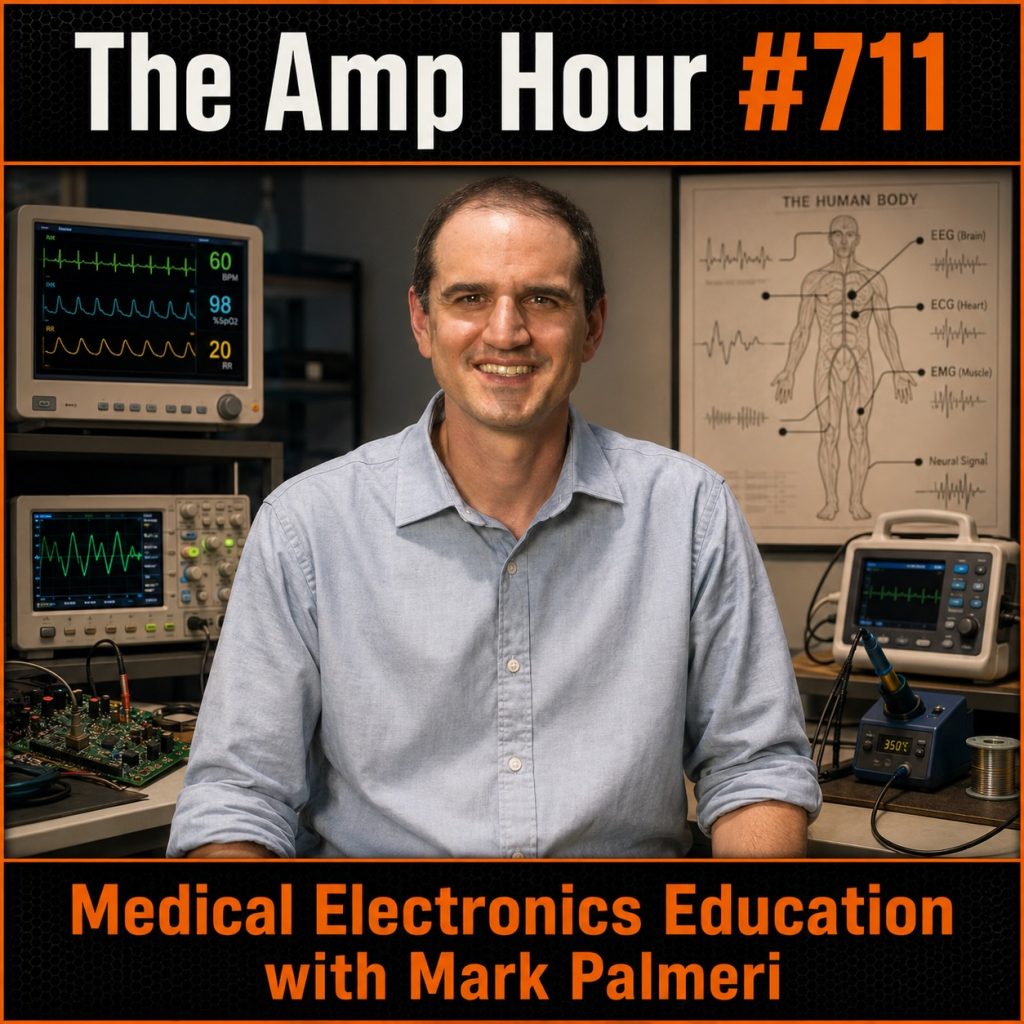
Welcome Dr Mark Palmeri, professor at Duke University!
- Mark has been at Duke since 1996, and has completed undergraduate, graduate, medical, and PhD degrees here (!)
- He has focused on making medical devices and now teaches others to do the same in his Biomedical Engineering (BME) courses
- Verification and Validation (v&v) is a large constraint in getting a regulated medical device to market
- BME design fellows is a program that guides students towards real world use cases and design projects
- The courses that Mark runs reminds Chris of “automatic job offers” that Chris has heard about for classes like those taught by former guest Larry Sears (at CWRU). Also SMPS design courses at UT Dallas and microarchitecture courses like those taught at University of Michigan.
- Teaching the skills of troubleshooting / debug
- Putting together circuits like Legos
- There are difficulties when teaching students with various levels of experience, namely how deep to go on any particular subject and how much background to provide.
- Mark has been flipping a circuit course on its head, instead prompting students with ideas like “how do you capture bio signals electronically and pull them into a microcontroller”
- Tools of the trade for Mark’s courses include
- KiCad
- ngspice (built in to KiCad)
- Jupyter notebooks
- VS code
- Git
- Zephyr
- Talking about power as an intuition builder, as opposed to currents or voltages
- V&V requires that you have a quality management system (QMS)
- IEC60601
- Going through companies that have QMS can be a shorter path for bringing a device to market
- Even face shields needed to go through that process when COVID hit
- Firmware and embedded in BME at graduate level
- Mark and students in BME Design Fellows course have been working on a Tympanometer, targeted at resource constrained industries
- Mark also teaches students how to use Zephyr, as opposed to how most educational programs migrate towards arduino
- A challenge for teaching Zephyr is the devicetreed
- They target Nordic Semiconductor parts, which have great support and educational resources
- Mark experienced a “vertical learning curve” when first migrating designs to Zephyr a few years ago
- Complicating things is that most students haven’t coded in C, if they have done much code at all
- Teaching how to lock to a particular version with Zephyr manifests
- Using CI/CD for automated builds
- Focusing on state machines early on, using Zephyr’s state machine framework (SMF)
- All of Mark’s courses are on github under his username
mlp6 - Teaching stack vs heap
- Mark only ever has taken one official progrmming course
- The benefits of experiential learning
- Accreditation is a constant challenge with non-standard courses and testing
- Duke is taking retrospective and prospective looks at the space of education
- Problem sets are moot these days
- Mark gave a great example about teaching a student about Bode Plots
- “Thats a trick problem” is something Mark hears wrt testing (when it’s definitely not)
- “Getting the reps in” is an important concept in educational contexts, and something Chris really resonates with
- Building open ended problems vs closed
- The more open ended a problem, the more time it take to grade / evaluate
- TI-85 / 83 / 92 calculators
- Jupyter notebooks as a way to track progress and have students show their work
- More about the tympanometer project
- They have been working with Duke hospital, a major benefit for Mark and his BME colleagues
- Continuous middle ear infection that causes scarring that causes lifelong loss
- Sound reflection under vacuum is an indicator that more testing is needed
- The key innovation is making it lower cost and allow a layperson to do the screening to hand off a child to get more screening at a pro clinic
- BME Design Fellow students getting to design the various parts of the design
- They have multiple sources of funding: private, nih, etc
- Value engineering in medical space
- Mark points out the philosophical question on whether you can reduce costs by reducing testing … but thinking about whyat that takes to satisfy that need
- Find Mark online