
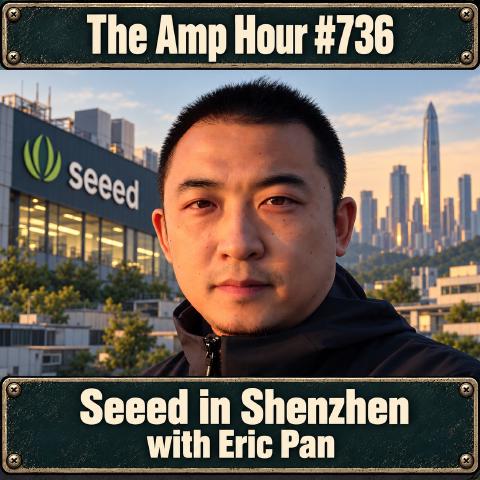
#736 – Seeed in Shenzhen with Eric Pan
Download episode · 74 MB
Also on Apple · Spotify · YouTube · RSS
Show Notes
Eric Pan is the founder and CEO of Seeed Studio, an open-source hardware and manufacturing platform based in Shenzhen, China. He joins Chris to discuss Seeed’s journey from early open-source roots to modern robotics, navigating the hardware ecosystem in Shenzhen, bridging the gap between semiconductor companies and developers, and how physical AI and low-cost hardware platforms are transforming innovation.
Timeline
- Chris welcomes Eric Pan, founder and CEO of Seeed Studio, to discuss open-source hardware, the evolution of Shenzhen, and the emerging robotics ecosystem. (00:00:15)
- Eric recounts founding Seeed Studio in Shenzhen in 2008, starting with just two people committed to open hardware. (00:02:45)
- Eric discusses his background working at Intel and how Seeed’s earliest projects supported artists and interactive installations needing custom electronics. (00:05:30)
- Chris and Eric reminisce about the landmark 2015 Maker Faire Shenzhen and look forward to its return this December. (00:09:15)
- How hardware startups, suppliers, and maker spaces collaborate, share resources, and exchange talent across Shenzhen. (00:13:00)
- How the process of procuring components, tooling, and materials in Shenzhen has transformed over the past decade. (00:16:45)
- How Shenzhen’s modular electronics supply chain is pivoting to support rapid prototyping and production of robotic platforms. (00:20:30)
- Looking at Espressif Systems as a standout model of a domestic chip company that built a global market by championing developer communities and open-source software. (00:24:15)
- Why traditional semiconductor manufacturers are often hesitant to fund grassroots developer support, and the cost of neglecting community adoption. (00:27:45)
- How silicon vendors like Rockchip engage with open hardware ecosystems and community developers. (00:31:15)
- Brief audio dropout during the recording session. (00:34:45)
- The engineering philosophy behind creating the thumb-sized Seeed Studio XIAO microcontroller board series and packing high compute into minimal footprints. (00:35:15)
- Assessing the rise of “vibe coding” and how generative AI code assistants are influencing firmware development and electronics prototyping. (00:38:00)
- Exploring whether large language models and software automation threaten hardware platforms or act as powerful accelerators for engineers. (00:40:45)
- Brief recording interruption. (00:43:00)
- How rapid tooling and AI-assisted workflows speed up iteration cycles for physical electronics. (00:43:15)
- How Seeed is moving beyond board manufacturing to act as an ecosystem advisor connecting silicon vendors, factories, and developers. (00:45:15)
- Eric shares his perspective on viewing Shenzhen’s manufacturing hub as an open supermarket of modular resources rather than a cutthroat arena. (00:47:30)
- Exploring the shift from pure software models to embodied intelligence, connecting back to Chris’s conversation on Episode 732: Hands-on Physical AI with Kevin Cloutier. (00:49:45)
- Chris discusses purchasing the SO-101 Robot Arm Kit, which he previously mentioned in Episode 734, and how Seeed stepped in to support DIY builders who kept asking for assembly and calibration help. (00:52:00)
- How the open-source LeRobot framework is democratizing imitation learning, teleoperation, and robotics training. (00:54:15)
- Discussing the open-source Pollen Robotics Microduck bipedal robot and reinforcement learning sim-to-real pipelines. (00:56:30)
- Why sub-$200 open-source kits and standardized software stacks are lowering barriers to robotics education. (00:58:30)
- Seeed’s collaboration with NVIDIA around Jetson hardware for edge AI and robot control. (01:00:15)
- How Seeed serves as a vital bridge between chipmakers and global developer communities. (01:01:45)
- The practical realities of modern factory automation on the ground in Shenzhen. (01:03:00)
- Exploring the full spectrum of industrial automation—from simple fixtures and cobots all the way up to humanoid robots. (01:04:15)
- How the Seeed Fusion PCBA turnkey service helps hardware innovators prototype and scale production. (01:05:30)
Transcript
Intro announcer: This is the Amp Hour. Released October 7, 2026. Episode 736. Seeed in Shenzhen with Eric Pan.
Chris Gammell: Welcome to the Amp Hour. I'm Chris Gammell of Contextual Electronics.
Eric Pan: Hello, I'm Eric Pan from Seeed Studio.
Chris Gammell: Welcome, Eric. I think people will definitely know you. I think they'll know Seeed Studio. And I'm very, very excited to talk to you today.
Eric Pan: Happy to. We have been surviving for 18 years now.
Chris Gammell: 18 years.
Eric Pan: And a lot of stories we can unwrap.
Chris Gammell: Yeah. Yeah.
Eric Pan: It's quite a journey.
Chris Gammell: That's great. That's really great. I want to start at the top with just a compliment. I think I saw this on your website. I haven't looked in the past couple days, but did I see that Seeed now has a tagline that says the arms dealer for the maker movement?
Eric Pan: I think we don't see it officially, but some people comment in a very vivid manner.
Chris Gammell: I know it's kind of like a little spicy, but I love it, actually. It's pretty true. I mean, it's like, you know, just need to go and get all the things to let me build all the things. And that's a really fun thing to say about it, I think. So it's great. If people don't know what Seeed is, could you explain what Seeed is and kind of like broad strokes?
Eric Pan: So we've been providing open source hardware from 2008, all the way from modules, now to devices and solutions, all the way from all kinds of sensors, HAI, robots. Yeah. So people come to us and get the parts built to their prototypes. But I think we are very different from other people is we also help people to scale their products into real productions and distribute all over the world. So we have been providing end-to-end services.
Chris Gammell: I've been really interested to see how that's grown over time, too. It seems like each, you know, year that, you know, you guys offer new services, your catalog obviously is massive, but then the PCB services and like the actual build-out stuff, like you said, it's really grown quite a bit in that way. Relatively, how big is the company? Like how many people are at Seeed these days?
Eric Pan: We have been hiring a lot. Recently, we have about 500 people now because all the physical AI, like all the hardware is now being, it's like ghost in the shell. We have all the shells now. People are building more ghosts and it's time to rebuild everything with AI. We have been answering to a lot of incoming requests. We have grown a lot.
Chris Gammell: That's great. And so Seeed is based out of Shenzhen, is that right?
Eric Pan: Yep. Our headquarters is Shenzhen and we also have people all over the world, in Japan, in the States, in Europe.
Chris Gammell: It's actually a great embarrassment of mine that like I kind of just, I view Shenzhen as like the, you know, the center of the electronics universe, you know, and I've still, it's yet, I've yet to visit, yet to be there. You know, obviously I've followed lots of people who have visited and things like that, but I'm actually even more embarrassed that I think this might be the first time that I've had someone that's like living and working and like from the area actually on the show as well. So apologies to the audience and, you know, apologies I haven't had you on sooner just because I feel like it's a disservice not to talk to people that are like in the thick of it and actually like building stuff at kind of ground zero for where all this stuff's happening.
Eric Pan: Yeah, this is my strongest drive to join the conversation too. Like how could you have 700 episodes but nobody from Shenzhen talking about it? And I need to send my invitations to make a fair. Maybe in December you can come join us. And I think you can interview so many people doing hardware by that time.
Chris Gammell: Yeah, that'd be great. That'd be great. Well, I mean, even just since 2008, can you, so maybe we could start first with just like ecosystem, just ecosystem discussion, like how you got started with Seeed, what it was like in 2008, obviously just insane growth of the electronics industry. You know, a little bit prior to that, you know, I've only, like I said, I've only viewed it from the outside reading things like Apple and China and other similar pieces. But like, obviously you're there, you're doing the hard work every day. How have you seen the ecosystem changing both as part of it but then around you as well?
Eric Pan: I think that's the trick question. We start this company very humbly, very organically. We start with two people because we have nothing else to do. I quit it from Intel about two years ago before I started. Then went around to try all kinds of jobs but I found out there is some artists, interactive installation makers. So I don't even know what is a maker until I see what they do. They are using Arduino boards to build solutions for art. But then I look at what the way they build is very preliminary because I'm double E professional. So I think there's so many things we can do for them. And I came to Shenzhen and we start to like join the community. I'm a maker myself. So it's very easy to understand how people are missing and how can we help them. And we start to build more like sensors, Arduino shields, all kinds of extension boards. So this is quite interesting beginning. In Shenzhen, in 2008, nobody knows about makers. Nobody cares about startups. Everybody is just, okay, let's build something for consumer electronics and whoever has the quantity, we serve them with priority. But we're becoming, how to say, a portal in between. We first go to the Arduino forum. We talk to people in the community and understand what we can do for them. And we deliver the result very fast. Like the first day, people talk about, okay, we might need RGB dot metrics. The next day, I go to the market to store some dot metrics and come back with some demos. So people are amazed to see what's the possibilities. So see the studio by that time, very few people know that. And on the other end, I need to go to the vendors in Huashianbei in the Antroni market. I explain what is open source hardware makers and previously they don't care. So I'm just telling them, okay, I need to do education. I go to the market every day so people see me in familiar faces. People see me carrying a lot of cargo products around the market. So they see me as a decent buyer. And I get to know more and more of them. So I'm becoming a portal in between. And after that, we start to build more of our stuff. We hire more people. We do our own manufacturing. So I can basically say for 18 years, we are doing the similar things. The structure, the business model of CETA is built from day one. Although we have been keeping constructing it, keeping making it more end-to-end, so the makers are getting easier to build things. In the very beginning, people need to do a lot of stuff to really deliver something in small scale. But after 18 years, we can see today is, okay, with web coding, with all the open source hardware, you just name what, just customize from existing hardware. And the ecosystem I cannot, maybe I will just try to describe in a short manner is, in 2008, everything is like in the Wild West. Everything is so bad, but it feels so good because you can create things to, or chest-train everything. But after like 18 years, after 10 years, in 2015, it has been changed. Another, by that time, it was about spam hardware, which means like squeezing a Wi-Fi module or Bluetooth module into something with power. And the people building connected everything, like connected cups, connected movers, connected drones. So, by that time, so many people come all the way from Silicon Valley, all over the world, from Beijing to Shenzhen. People were, it was the last, peak hour of Shenzhen, people talking about the hardware, they say that the hardware is new software. But by that time, there was a very interesting period, that in the States and in China, there was massive startup and entrepreneur movement. Everybody started to believe making hardware is like a band. It's just gathered three people and started to build something and raise some money. And they did. A lot of people failed because they are not close enough to the supply chain. They don't know what's the restrictions. They don't design from manufacturer. They just blindly want to build everything by themselves. On contrast, the startups in Shenzhen or the startups in China, they are more on the supply chain side. They start to know, how can we do the branding? How can we do a design to make my product different? So 10 years ago, it was quite an interesting stage. Like as we see today, Acre, Bamboo Labs, like DJI, are popping up from that after five years. And the people start to do something very different. And they capture the market. They scale up. They outbid, like Insta360 DJI, outbid GoPro in the price, in the speed of innovations, like about everything. So the hardware in the West, in Silicon Valley, has been silenced for many years. And now, I think it's coming back to a new period of heat. It's AI. AI. As generative AI goes into more boundaries of hardware, people need to build new scenarios to use AI. They need hardware. So it's very much AI driven, but hardware as a carrier. So many startup in Silicon Valley start to come to Shenzhen again. They start to think, how can we work with ecosystem? I think it's becoming a lot more, how say, effective, a lot more influential because it's not, again, some trial of new gadgets. For now, I think this period of, this really changed the world with AI and some hardware combined. And it's much faster than the last wave. This is why we see the ecosystem. Everything surely is more mature, but competition is far more intense. And we need to rethink what would be the most complementary way to work together.
Chris Gammell: I mean, at this point, just hearing your timelines as well, like I'm kind of casting my mind back to that time that it's, Eric, I feel so old, man. Like, you know, the amp hour started in 2010. We were talking about, I think, Arduino within a day or two of the, or within one or two shows. And similarly, we had Massimo on the show since then. And, you know, just thinking about like how the maker movement has progressed and then morphed and then, you know, kind of became industrialized and then de-industrialized or decentralized and similar. And yeah, it is interesting how it's kind of circling back around now. Yep. So you would mark like the, like the, would it be like the Maker Faire Shenzhen is like the, is that like the marker of like when it kind of became legit and, you know, like, like people really paid attention in Shenzhen to the maker movement. I mean, I remember there was like a bunch of, I remember a friend or two that went to that and they were, they were very impressed by just the level of the entrepreneurship and like people wanting to build companies and stuff like that. Is that about the timeframe when it all kind of launched?
Eric Pan: We launched the maker first sensor in, in 2012. So it has been years. In the very beginning, people don't buy Maker Faire. We have to push out and it's just more. But only after a few years, like 2014, like DJI started to join us to shoot DJI was more and Chris Anderson, like more people come. In 2015, it's quite explosive. Like we have, how many people? 190,000 people.
Chris Gammell: Wow. Okay. Yeah, that's legit. Yeah. Wow.
Eric Pan: That's wild. I think that's another thing
Chris Gammell: that's like, that comes across is just the, just the scale difference. You know, like so many things where like, you know, I'm like, oh, well, I guess I'll, I'll go shop on DigiKey and, you know, like, oh, there's, you know, obviously the millions of parts of my fingertips, but like the same kind of scale and of like parts being available on hand at the markets, you know, just direct access like that is just so, so different for me that it, that it does change everything about how the ecosystem can operate. And then I think within that, then you have the, just more people doing more things. You have a wider spectrum of, you know, high performers that can really like supercharge. Like you said, the DJIs of the world as well, seeds of the world, you know, being able to do these things that are outpacing anything I can imagine myself doing, you know?
Eric Pan: Yup. And I think 2015 was the biggest make affair, but that was not, that was still early because people have come, came with curiosity. They were curious about how people innovate, how people do startups. So most of the people are visitors and trying to understand. And the government is pushing hard. But after that, it's COVID, it's a lot of things damaging the offline traffic and we don't do it for two years. Yeah. But I think now it's getting more organic. We still have about 40,000 visitors every year and we don't do any like promotions outside of the circle. So it's just the people wear it by mouth or people following our WeChat like accounts, they come to join us. It's becoming very different. I think the make affair in Shenzhen, if you have a chance coming this December, is people are a lot more confident, a lot more, how to say, how to say, we are abusing the resources of the industry here. Okay. Like we don't, we don't buy parts from DQ and build from scratch. We just go to like a DJI factory. We go to like all kinds of existing factory building professional things and we're trying to hack them. We're trying to hack the supply chains for something more innovative. So it's, we're competing with each other in the ecosystem but we advance quite fast.
Chris Gammell: Yeah, so like further up market, further layering of value chains on top of value chains sort of thing, right?
Eric Pan: Exactly, exactly. And people flow. People go like quit DJI, people quit DJI to create BAMP Labs. People go from a professional industrial robot company now joining startups to build robots. So a lot of experiences, know-hows has been inherited by that way. And make it fair is still the way people find teammates, people find investors, people talk about with each other about something which is potential like a, but very differentiating from mainstream. So it's becoming very different. Like we go, we still go to make affairs around the world and I feel sometimes boring.
Chris Gammell: It's not as dynamic.
Eric Pan: Sorry to be a little bit spicy but I feel we should have more exchanges. We need to invite more people to center and we should go more to the make affairs to demonstrate what's possible. I think the our key differences in center we don't see the making movement or the makerspace as a gym. We don't go there just for culture or possibilities. We work on this stuff for productivity. We build something to survive. We build something to win our markets to build a different kingdom. So like we go to other make affairs, okay, it's still the same 10 years ago. So people still enjoying them a lot. I respect that. I admire that. But in Shenzhen, we are suffering. We are working hard. We are worried but we are building something which trying to be more advanced and different. I think that but it's not only Chinese people. It's like people from all over the world that gather in Shenzhen. It's like Hollywood. We don't make indie movies that much but we make movies that can be going to everywhere which sometimes is bad. Well,
Chris Gammell: I can imagine that could hurt culture potentially as well, right? That could be like it sounds like it's a little bit more I wouldn't say cutthroat but just more competitive more
Eric Pan: not frantic like I think it's another type
Chris Gammell: more energized,
Eric Pan: right? Yeah, I think it's another type of culture.
Chris Gammell: Yeah, right, right, right. Yeah,
Eric Pan: I think we are saying like Shenzhen is like future and amplifier so whoever don't want to lay back who don't want to have a balanced life who just want to be aggressive enough come to Shenzhen and state. Then we compete with each other and serve the global needs.
Chris Gammell: Yeah, I mean, I think people would say the same thing about like, I mean, up until recently, like, you know, doing software, it's like, oh, you got to go to Silicon Valley. You got to, you know, you got to go to San Francisco. You got to go to these places where the same kind of like high, fast pace, big, big risk, big reward type of things but people moving fast because they both feel compelled to but they're also they want to feel that competing feeling. It sounds like just in the hardware space, Shenzhen has that same like, like bubbling energy that some people want to jump in the current and, you know, and, and, you know, flow upstream and some people want to step outside the current and that's, both are okay but it's like, it's kind of like pick your own adventure sort of thing.
Eric Pan: Yep, exactly.
Chris Gammell: Well, that makes me want to go. I mean, I want to see, you know.
Eric Pan: It's just a ticket away.
Chris Gammell: Yeah, yeah, right. Yeah, and a, and a, and a permission slip from the wife. Uh, free heart,
Eric Pan: free heart skater.
Chris Gammell: Yeah, yeah, yeah, yeah, yeah. What about like the, so then, so now you're saying like, we're talking about moving up, up the value chain, moving up, just like the, moving up the stack generally, right? Like doing more with assemblies now instead of low level components, doing more in that way. Does that mean that, so now as someone who's not only serving the needs of others but also building yourself, when you go to get something made now, just like in town, has that materially changed for like getting a, I mean, I know you build your own PCBs as well but like, just the variety of things that you might be able to order or choose to order locally, have you been noticing that shift over time as well in terms of like, actual materials you get, you're, you're getting built and made?
Eric Pan: I think material is, uh, the lesser part. You see it's good materials all over the world. It's more about the process you can, um, modify. So like, I'm going to make injection molding, what kind of a process, what kind of capability I can have. It's not that I don't do it from scratch. I go to the injection molding factories who has all the experiences building great stuff. And, uh, I respect their workers a lot. Even the frontier workers who don't speak English, they have dirty hands, they're doing it. They are, they are the masters. So we learn from them and we convince them that they see, we will find, we find out the most optimized way to build stuff together. So I think that's the most precious thing. It's not the materials only. Then it's all, it's also about the, uh, capabilities, like, uh, how many, uh, capabilities should they allocate for your project, which means your need time, which means your cost. So it's a, it's a, it's a, it's a manner of process to building consensus trusts.
Chris Gammell: But it is, it sounds like it is still because of just the, the volume of, of vendors and suppliers that are out there. It's still relationship based. And so like, just, just to give a comparison side, like, so, so now Chris sitting in North Carolina in the United States, like most of the time I don't have those relationships up the street or even in my state, right? Like nearby. So like, I'm then like, okay, well maybe I can find like a online portal for like a, you know, a laser cut assembly house or, you know, a laser cut service and I can go, you know, source through a variety of them. But that's because, uh, there's an online portal that's allowing me to kind of access a range of them within a relatively, you know, within a shipping distance sort of thing. Are you seeing that same shift on the ground in Shenzhen or is it still like, ah, you know what, I'm going to go to the, to the arena where a lot of laser cutter folks are and find the best ones within that, that space.
Eric Pan: Yeah, surely it's much faster than the, the, the narrow way. You can still do online, but if your project is a very, uh, less competitive one, you can do it in your domain slowly. No, no, no problem for that. It's a, it's a, I think it's a better choice, but if you are doing something, uh, you're trying to be ahead of everyone else. I think you should be in Shenzhen. You should be like, go to the arenas and talk to different people and get introduced and go to their factories to try the samples not to wait for like, a one week, uh, shipping. So it's much faster.
Chris Gammell: Yeah. Yeah. Yeah. So like that same, like supercharged, bubbling energy. It's like, you know what, I'll just go there. I'll check it out. I'll have those interactions. It'll be faster. That, that kind of like just fast feedback cycle. Exactly. Exactly. Supercharge your process as well.
Eric Pan: Yeah. And you can find the people to work with instead of trying to learn how can I do this? Just go to find the people and work with them.
Chris Gammell: You'd mentioned kind of like the, the advanced processes as well. Like what, what are the, you know, so when you, you go shopping or when your team goes shopping for like a new process, new capability, what's some stuff that you've seen recently that like, that might be available there that I'm like, that, that I'm, it's going to blow my mind. You know, that sort of thing. Like in terms of like new capabilities, are there, is it truly process-based where it is like speed of delivery and, and cost, lower cost? Or is it, is it actually like entirely new processes and ways to process materials?
Eric Pan: Yeah, I think materials, um, um, we divide into several parts. Like for intronics, it's a very mature, nothing too beautifully strange. Um, but you look at the mechanic parts, especially for robots, there's a lot of advancement. You will build a very small, very good, very powerful motors because of, uh, all the machines people built. You look at the 3D printers, imagine you can use your, uh, motors, you can use your controller boards for whatever other robots. And also there are, like, uh, AI sensors, like for cameras, optical, thermals. This sensor has been advanced a lot. And also if you look at the AI, AI glasses, the parts using glasses, they are small and they are bright light and very good quality. All these consumer electronics has been training the supply chains to be more advanced and we can sooner or later have a way to repurpose it. Yeah. This is my needs. This, I keep looking at all these beautiful closed things and think of how can we open source that? How can we repurpose their parts for the global makers?
Chris Gammell: Right, right, right. So giving a second life, almost like, uh, I always think about like the, you know, the Raspberry Pi and like they're using like a chip that was like 10 years old when they started with it, you know, like the Broadcom part and just like, man, that, that really, that gave that chip a second, third, fourth, fifth, and sixth life. Right. I mean, it's just like, it's amazing that it's, you know, like the things that, that consumer leading edge type processes that can be repurposed. It's like, yeah, it's wild. Yeah. What can, what can then be enabled for schlubs like me, basically, you know?
Eric Pan: Yeah. I think this is happening more. Like you, you, you, even look at these days, the ink display, e-papers, they have been pervasive.
Chris Gammell: Yeah. Yeah.
Eric Pan: Like about, uh, how many, 13 years ago, we did the open source badge. Oh, the open source hardware badge, which was the first, uh, e-ink. That was expensive. But now because of the tax, like e-paper tax, we have so many cheap and good e-papers in different sizes, colors. And, uh, it's, people are repurposing that. People are reputing their projects with these components.
Chris Gammell: I actually, that's a, that's a really good example too, because I, I don't really get a lot of exposure. Like, like we were talking about, like you can walk down to the markets, you can kind of see what's out there. You can see it like viscerally in person, whatever. I get it like once in a while, like I was at embedded world last year. I remember walking by this one booth and that, that damn e-paper was probably flashing for like 35 seconds, but it was doing like 25 colors. And, you know, it was like, it was, uh, you know, it was like a 450 millimeter, tall picture frame. Effective. It was just like unreal. The amount of stuff that was going on. I didn't ask the price. I didn't want to know the price, but like, but just the amount, the scale difference of like what that is versus what I'm used to. And, you know, like the Kindle from 10 years ago, you know, that, that, that scale difference is wild. Yeah. So are you seeing other things like that? I mean, like, uh, on the electronic side, are you seeing chipsets that are available there that might be having things that are maybe not broadly available as well? Or is that, is that kind of more equally available to people outside the ecosystem as well?
Eric Pan: I think this is a, this is a, this is a one of the strong area we want, we are like working at. If you look at all the chipsets used in your watches, in your, uh, all kinds of devices, they're powerful chip, but they are not open. But thanks to the Raspberry Pi, thanks to all the open source movements, the silicone providers start to understand that. They want to open source. They want to work with the developers. And I think it's a chance. Like, I think one only example is expressive. ESP32. Now, if I use it, yeah, right. But, uh, in the beginning, I especially didn't understand the developers community that now they are very benefited. So they said as an example, other chipset factory, any, uh, other chipset vendors look at this and I think, okay, how can we do that? So I think sooner or later, later, we are going to have a lot more.
Chris Gammell: It is tough to like, try and encourage, you know, chip companies, I feel like are made on like large scale deployments, right? Like it's just like the, the unit economics almost require it. So then it's like, well, no, no, but maybe, maybe one person will buy it like for 10 pieces at a time. It's like, well, they don't really care about that. But then if you do have an example, like you mentioned with Espressif of just like, yeah, but who knows where that's going to make it then. And just scaling it out, you know, scaling horizontally to like a huge community, then you really start to see a lot of benefits. Do you think that they're bought in enough though, to really support it? Like where, where it's needed, like to the same level. I mean, like Espressif went for it, right? But like, do you think other companies are willing to do that same level of, of like developer support?
Eric Pan: Uh, they have different degree of, uh, readiness, but you can look at a call. They bought Arduino wants to be working for the developers community.
Chris Gammell: Sure. Yeah. Good point.
Eric Pan: And, uh, uh, I think it's a must for most of the silicon companies, because you don't have one single device that can rule the world in the future. It's going to be very standard, very diversified. Nobody knows what will be the next device that's going to be most popular. Even glasses. Everybody might be wearing air glasses, but, uh, everybody's glasses should be, be very different. So I think it's, uh, it's doomed to be scattered. So the silicon, the silicon vendors, after they done all the marketing surveys, they cannot find the singular answers they have to change. And, uh, there is big companies like Hawkeye already leading the change.
Chris Gammell: Yeah. Yeah. Yeah.
Eric Pan: So I, the most of the silicon vendors I talk to, maybe it's BS, but, uh, they are very willing, but they're not ready. Like their software teams don't know how to do that. They don't, they don't have tests to prepare a proper SDK even, but they will get there.
Chris Gammell: Yeah. I think it's like, uh, they're like, yeah, that's a great idea. We'd love to have a big developer community. Like, okay, how much money are you putting towards it? They're like, no, no, no. We'd love a big developer community. It's like, no, no. One has to start before the other starts. Unfortunately, it's like, no, you got to like hire people to like support it software side. And like, yeah, it's, it's its own thing. Right. I mean, is that a space where you see Seeed, like kind of moving in that space too, on like the support side and like helping develop, sure. Sure. You know, SDK kind of support and building groundswell.
Eric Pan: Like we, we might not be building all the SDKs, but we'll at least be the pilot users. And to, to let, to tell them what's missing. And also like with all the web codings, the requirement for documentation for SDK is much more like lowered. You, you, you just need to like prepare the basics and let the agent feel the rest with proper skills. I think it's getting much, much more easier. So we just need to push them a little bit.
Chris Gammell: Yeah. It's, it's an interesting time because, yeah, because of all the coding agents, stuff like it. I mean, I have noticed that you guys use a lot of Rockchip, right? Is that, is that a, a common vendor in, uh, inside Seeed?
Eric Pan: Yeah. Uh, rock, Rockchip has been, um, like picking up for much faster because of, uh, it's, it's cost and, uh, availability. Most of availability, availability, like buying a raspberry pie is, uh, you have to wait if you have large, uh, orders, but a Rockchip is a very available. So in scaled projects, sometimes we have to force to change to work chip. Now we have reference designs. So people, if they needed something different, we have that.
Chris Gammell: Yeah. A lot of like the re computer, I've seen that there's like, um, like a CM four style breakout type things. Like I've seen like a, a bunch of them come across my desk and just checking them out and things like it. And they, and they have like different distributions available as well. Right.
Eric Pan: Yeah. This guy has, has saved many projects. Like even our own projects. Got it. Yeah. You, you have to have some SPC to do the job.
Chris Gammell: Yeah. I haven't really tried it much. I think maybe I had, it was the banana pie. Was that built on a Rockchip? Is that right?
Eric Pan: So banana pie was beauty on a winner. So they have Rockchip version. Oh yeah. There are several windows. Yeah. Yeah. Yeah. But I think for Singapore computer, the software is quite a, um, migratable. You can just port your software pretty easily.
Chris Gammell: I definitely want to like take, carve a whole time out for just for robotics and like physically AI. Cause I feel like that is such an interesting and awesome space. I just wanted to quickly dip a toe. I was looking at the, the, the Microduck, the hugging face Microduck that you guys are, you're working on as well. Right. And, uh, that's a, that's a Rockchip. I believe in there as well. Right. Like that's like a custom build for a Rockchip processor in there.
Eric Pan: Yeah. Yeah. Uh, I think a Rockchip is there like configurations spec is, uh, uh, good for some of the robots.
Chris Gammell: It's not a direct replacement, but it is like a, it's like a, like a device tree almost replacement, right? It's like, you're still putting a distribution on there. You have, uh, a board that's potentially pin compatible with something like a, a CM4, Raspberry Pis type thing. Right.
Eric Pan: It's a good alternative for shortages.
Chris Gammell: Well, what about other like chip sets that, that, um, you know, Seeed is Seeed is kind of focusing on as well. Cause I mean, I, I've, I've also kind of dived into the XIAO line quite a bit, you know, in the, that's the very, very small, um, pluggable form factor. Um, is there particular, you know, areas I, I expressive. I think I have some psy labs parts in there is like kind of, what is, what is the decision process behind making a new, a new XIAO style board?
Eric Pan: Well, uh, I don't actually know the process of that. Like my team just built it. It's more like a per their, uh, preferences. They, they look at, they keep looking at the new chip sets. They find something different, same exciting. They just build into XIAO. And we also, we have our preferences on the NPO. So if these are, it's a SBC or it's a microcontroller with AI capabilities, we like adopt that. So like for this, a few years ago, we started with the high max. They have very good, like a M55, uh, I'm architecture, MCUs. So they can, they can deliver like a very fast on the age inferences. And we, we excited about that. We appreciate it with all the software. And then now like a Rockchip, we are, we are carrying that because they have a, like three tops, six tops computation parts on a single SBC. And it's capable for a lot of, uh, on age tasks. So that's one of our priorities.
Chris Gammell: Specifically because so many vision, vision based things that want to have, want to have like onboard local processing, that sort of thing.
Eric Pan: Yeah. Even for large language models, people want to, to use it on age, not to explain everything to you, but to do some like a smart home, uh, applications or very high frame rates.
Chris Gammell: Yeah.
Eric Pan: Uh, like, uh, we are in usages.
Chris Gammell: I think that's actually, it might be a good time to actually just talk about, before we talk about the robotics, physically, I type stuff. Um, I am curious about just kind of vibes, uh, the vibes of vibe coding and, and similar, like, like on the ground in China as well, like Shenzhen elsewhere. Like I I've read articles, but I don't, you know, I don't know a lot of folks over there, but like, just like the interest level in AI based things, open claw, Hermes, similar type of like orchestration, their agents, like what's, what's your take? What do you, what are you seeing kind of like around town in terms of like interest levels around vibe coding and similar?
Eric Pan: I think there's nobody doubting about that. It's like, uh, people are thinking, how can we get involved in one kind of angle? So people are thinking to build everything again with AI. Like I'm already building a robot cleaner, working cleaner. How can I add AI into that? Yeah. And I'm building, uh, um, like a gadget, like badge. Now I need to build AI into that. So it's, I think it's consensus is very strong here. And, uh, the government, the businesses are pushing it a lot. You see unmanned vehicles everywhere, especially during even, especially in the nights. So yeah, it's, it's pervasive.
Chris Gammell: Really?
Eric Pan: So nobody's holding it back.
Chris Gammell: That's so that, so that's almost like, uh, well, that's like AI as a product feature that I was talking about. It more is like AI as a, it's like a development helper sort of thing. So just, just to let me paste my own internal thoughts about AI on top of it. Like I, I see, uh, LLMs and similar, right. So I see that I see Astra doing key CAD layouts and I see, obviously I, you know, using all these different GLM 5.3 to write firmware for me and similar type things. And then now we're talking about that versus like how a lot of people in Shenzhen are like offering services to people that weren't able to build themselves before, but now they are able to build potential, potentially able to build mind you, um, with AI tooling. So like I could see it being like a kind of a tension within people that are working in Shenzhen. Obviously that's a huge, huge audience generally, generally, but like, um, there's like LLMs being this enabler and like enabling the, this bubbling culture to go even, even faster. But then also on the other side, like the kind of the service level aspect of, of vendors in Shenzhen, seeing it as competition to the services they might've offered as well. Sure. Like where, where do you see that sort of stuff?
Eric Pan: It's, it's two, two things. Like how do we use AI to build things? Like for us people in Shenzhen, we, we don't use AI to build PCB because we have a professional engineers who has, uh, uh, the AI is not ready to compete on the hardware, um, button layer, but for the hardware teams in, in Shenzhen, they have benefited a lot, no matter on the coding or the design. So before our engineer like me, cannot build the embedded code, like the firmware so fast, but now I just wipe coding my firmware and I can build my website and can build a very good design, like, like designs, uh, even in one person's company. So this is, like a very complimentary to, uh, uh, uh, advantages. And second is how can we build things for AI? And, uh, it's just a chipset, right? It's just, uh, you squeeze a microcontroller or SBC into existing things and have, either it's some machine learning models or it's, uh, uh, uh, a hybrid or you have a cloud open cloud or Hermes living in your devices that can talk to the cloud and to learn and remember what you want. So I think it's, uh, there's nothing in the way it's more just philosophically. How do you see things, uh, uh, uh, I working with you or you are building like a physical agents that can work together by themselves and sometimes with you. So people have different, um, like a very diversified, uh,
Chris Gammell: You know, kind of the other side of the, the coin. I could, I could see obviously Shenzhen just being the, you know, if I go and dream up any idea, even in my own lab here, just the, the likelihood of like something being developed quickly being put together just as I, I want it to be. I'm probably just gonna, send it over to seeds service or send it over JLC service and just be like, And it's just going to come back and it's going to be good to go. It's a, so I could actually see it having an accelerate acceleration effect as well in terms of just more people kind of getting into the ecosystem. You know, so I've, what I'm really trying to say here is I have no idea where it's going to go. uh, yeah, I'm very curious to see how things develop on the ground in, in Shenzhen, you know, elsewhere. Um,
Eric Pan: it is, it's very interesting. Yeah. I think for the last, uh, 18 years, we're trying to help people to build a hardware, but for the last, uh, three to four years, I think we are trying very hard to convince people not to build hardware.
Chris Gammell: Interesting.
Eric Pan: Yeah. Uh, if you design something in, in North Carolina and use GRC to deliver the boards, it might still be too slow, but you look at existing gadgets, look at existing hardware and customize it, or just to put your firmware, put your data, your model into that to be part of your context. That's much faster and more reliable. Yeah.
Chris Gammell: So it's kind of like a zoom out effect of like, uh, so it's like going more holistic in terms of just being like a service provider of like a, you know, put in file, get gadget back. It's like, no, let's look at the best solution that will actually allow you to go to market, go to get scale quickly, that sort of thing. So it's almost like an advisory role, that kind of piece of it. Um,
Eric Pan: if we were put into a picture, it's like center is not the arena. Actually center is like the supermarket. Imagine you are a chef. You go to the supermarket to get the best, uh, but your, your battlefield is not incident.
Chris Gammell: Your arena is somewhere else.
Eric Pan: Maybe in your hometown that you need to, uh, fix some local challenges, maybe in your industry, which is not intronics, which might be, uh, agriculture, which might be, which might be, uh, which might be, uh, which might be like intronic, uh, electricity. Now you use the resources in center, but are your cook, uh, quite soon that fit into your scenario. I think that that might be a much better way. So it's, so something is not a computer with everybody, but, uh, I think at least us, I think we are trying to, uh, to enable people to innovate with center. That's good.
Chris Gammell: That's, It's like, you know, you're talking to me and you're like, Chris, what value are you going to bring by growing a new varietal of like scallions? Right. It's like the world, like, they might be great scallions, but the world probably doesn't need that. But if I make something that has scallions that I can go and shop for and find the best ones at Shenzhen or elsewhere, piecing that all together, I could maybe kind of move up the stack and build all that stuff as well. Yeah, it is. I like that analogy quite a bit.
Eric Pan: Yeah. I think let's see Shenzhen as a common base, but the frontier is, uh, all over the world.
Chris Gammell: Well, I, we would be remiss if, if one of those, one of those big ingredients is, is, uh, I recently bought an SO-101 kit from Seeed, uh, put it together. Thank you. It's fantastic. Yeah. It's, uh, beautifully, beautifully documented. Uh, very easy to assemble. Uh, and now I have a little, I have a little desktop robot follower and leader leader and follower arm. Um, obviously that is, I think one of the most, like the simplest examples of the many, many robots that you guys are, are building and really just physically more broadly. Like, what is your high level view of this? Right? Like, you know, you're the, you're the boss man. Where,
Eric Pan: where do you see this all going within Seeed and within the industry? So we didn't do robots for the beginning of 15 years. Like we, we were thinking, okay, robots are too, uh, how say too competitive, but until people keep asking for help. And then we build the robots from the robot, the arms, and then rich meaning Microduck. What, what, what do we see is, okay, as embodied AI or humanoids are getting more popular, we are, people are in need of something different. People need a robot that they can own, like the S0101 you're owning today. People don't want to be left behind. People don't want to get replaced. People want to be the owner of robots. So I think that's, that's a different drive. And the ways more people with everybody has a possibility to have a robots. We can train the robots together. We can put them into real usages much faster than today. So I think what we are doing about robots, you know, opposite manner. We don't build a closed source, the humanoids. We build open source, Robert parts from arm, from a torso, from a little view. Then people can assemble them into the robot. Assemble them into the spatial, specialized robots. So I think every scenario should have their own robots. Because with 3D printers, modular electronics, and the robot parts, you can build your robot arm. So people can have been extending that for the orchards, to pick fruits. So it should be people have the power. Experience makers have the, all the skills to redefine their robots. So we see a more diversified world. There's no crown in the world, but the robot has the power to do something. Yeah.
Chris Gammell: I mean, I saw it as like a relatively low cost way to like, just learn a whole new skill set. Like I, I have always kind of just stayed away from robots because I, I didn't really understand it. And now, now that I have on like on my desk and it's, it's very accessible. It's, you know, relatively friendly. the Microduck is probably the friendliest little robot I've ever seen. So that's, that's the new one that's coming out in December. Right. Um, I feel like it's, it's showing that it's like, it, for me, a lot of it is like seeing the kind of under the hood, like literally, cause I'm putting it together as well. Oh, okay. It's like, it's like a, it's like a serial line. That's like stringing a bunch of these servers together. Like I understand some of this stuff. Like it's, it's much, much demystified as a result. And then there's a whole new skill set. We had, uh, Kevin on the show talking about Kevin, Claudia talking about, you know, training, training robot systems as well. And like, that at least got me to the point where I was like, well I could potentially do that. Now that I have the robot, I understand it. So it's almost like this enabling thing, kind of like you mentioned, like having a 3d printer on your, your desk, it's like, It's like an X, Y stage and a Z stage. And like, I can at least visualize it and see, you know, I can break it and it's relatively low cost to, to recover from an error like that. And it's like that, that is an enabling thing to have something that's like affordable and on my desk.
Eric Pan: Yeah. It's, it's going to be more pervasive. I think it's a very convenient, uh, and easier for the hardware engineer to get involved in robots rather than software engineers, because you download your model, but it still have a lot of, uh, like, uh, hardware issues to debug. From the power to rail abilities, to all the noises or disconnected stuff. I think hardware engineers, if you go beyond the PCB boards, ask them further, you are the robotist.
Chris Gammell: Yeah. Exactly. Yeah. I have a new, new, new skill unlocked, right? One thing that's been really interesting as well, seeing like just your Seeed is obviously a big partner of NVIDIA. Obviously that's a huge piece into the robotics ecosystem. Like how did, how did that all come about as well? Like, so you're kind of one of the main, many distributors of NVIDIA stuff for the robotics space. Like it seems like that is a very critical, um, partnership as well.
Eric Pan: Yeah. we started with work with NVIDIA, I think seven, eight years ago as a first suggestion is published. And, uh, I think it's a very complimentary media need us, one of us to help influence more developers. And we want more powerful, like a modules for people to do something beyond the current capability. And that was a quite a win-win until today.
Chris Gammell: I'll be honest. When I first saw like the, the Jetson nano and similar things, like I didn't quite get it, you know, like my main experience with a lot of the dev boards that were coming out. I think that 10 years ago, whatever it was, I just always think about like, you know, drawing green boxes on top of cameras. And I didn't quite understand like why that was important. You know, I thought of it like security cameras, but now seeing it from the, the, the lens of like robotics as well. Oh, okay. I would like to get like why this is important. Why having this local processing is so important. And it does seem to really fit. That story really seems to kind of coalesce very, very well around all the things that seeds doing. Yeah.
Eric Pan: I think it's inevitable. You look at all the sci-fis. We are just a practicing on that. We're just making it a reality. Right. You will see more cyborgs. You will see more machines like humans. Yeah.
Chris Gammell: What's your, what's your take on the humanoid's? What's your take on humanoid robots generally?
Eric Pan: generally i think it's not practical for now it's too expensive okay like the economically that it
Chris Gammell: does not compute i mean that well how about the SO-101 has what like six six servos and that's like one one simple relatively simple arm and then yeah i think about like how many servos are like getting the thing to stand up and or like the i saw the the beijing like uh the robot races that was yeah yeah oh my god it's just like they're very very advanced but i think though those those robots must have been god so expensive they look so expensive you know it's wild yeah yeah so um
Eric Pan: i think we can wait we can wait on until the human noise becoming cheaper and cheaper and easier to use but before that i think it's more practical is to look into the real missions and design some tools to resolve the problem and which happens to be a robot which means it has perceptions yeah has uh like uh its algorithms to understand what's going on and decide and have some educators to change the objects i think that's good enough to as a robot even a smart home is a robot we are just in its belly so we don't need to be looking at the robots as human noise i think it's two different concepts so
Chris Gammell: like i love watching like factory tours you know obviously scotty from strange parts we've had him on the show and obviously other people that just kind of go around and especially in like shenzhen factories that will like allow filming to happen you know just the the amount of like like mechanical automation and and it's just so impressive like the machine builders that are that are out and out in shenzhen like building these super complex manufacturing processes i think the one i always think about is like i saw like a flat battery pouch manufacturing tour it's just like so so amazing the amount of things that are there to obviously keep people safe but like that is just all robots but that is very very different in my mind from like the humanoid stuff where i feel like a lot of that is uh you know control systems and you know plc's and similar still it's it's not at the same level of like vision system you know some have vision systems but most of the time it's just like no no actuate this do that have safety interlocks all that it's like the the old ways are the best ways sometimes right i'm not sure how the factory
Eric Pan: tours can really help people because you look at the factory okay it's amazing it's something i don't know before like but how how does that helps your to design your stuff or resolve your problems i think it's it's good to see from the even from outside from the videos um but after that i think that's not the the interface for most of the people so i'm a bit bored of the factory tours maybe i have done too
Chris Gammell: many of them uh well yeah i think you you might have a particular insight into a lot more of them than i you know i'm an outsider right so yeah it's like uh yeah i how about this when i used to work in a fab i thought it was the the first three months of seeing like a robot move a foop of like wafers around was so cool and then like every month after that was just like oh god get these things out of here it was like oh another day in a bunny suit this is terrible you know it's like it's so cool at the
Eric Pan: beginning but yeah i i'm sure it loses its sheen pretty fast yeah i think um i i'm not to saying the factory is not good for everyone but i think i'm trying to say the factory tour is not important to everyone unless you are doing automations unless you are you're building something into the process like i'm trying to hack the closest i could i could have living factory to understand process and trying to squeeze my electronics into that or a bag factory that i've been building a smarter bag so i think it's worthwhile but not just wandering to random factories that fun interesting but not relevant if i'm building a robot so i definitely need to go to the robot factory to see how they assemble them so i can design to make it easier yeah yeah i think the reason the reason i brought it
Chris Gammell: up was just because i think the majority of like kind of kind of like the middle ground we were talking i think we were talking about on the on the same path was like there's some somewhere between like humanoids as like the most complex like over the top not really needed now and there's like there's like the automation the factory automation is like simple but like incredibly effective and and very very well deployed throughout throughout factories in china and similar just automation throughout factories right i'm all over the world and then there is something in the middle i was just saying that like at the automation level in the factories that's an example of like quote unquote robots that are really plcs and actuators and similar right they are technically robots but it's like they don't they don't have all the in-between stuff that is what we think about is like vision systems and vlas and all the things that
Eric Pan: are out there now yeah more flexible but they will probably more flexible process is in i think it's uh critical for the next stage you see the most automated factories are building simple ingredients yes right they they have all the automations but they just because what they build is uh simple and abundant but to to build a robots is still mostly uh handmade so i think we we need a different tool got it so you're talking about like
Chris Gammell: high volume low mix is like on the automation side of the scale and then like the humanoid thing is like the the futuristic like the low lowest volume highest mix and then somewhere in the middle is what we're talking about of like maybe some automation some smart some some interoperability because it has you know vision systems and capabilities to to be more flexible that kind of idea yeah yeah yeah we're shooting down the same path as it's good it's good i think we've we found it yeah that's great i mean uh what are you what are you excited about i mean 18 years in that's that's a long time to be doing Seeed studio but obviously you're you're still going strong so what are you excited about in the next six months year two years five years i think definitely physical ai
Eric Pan: like uh i think it's very similar feeling but much bigger than 10 years ago like 10 years ago was smart hardware iot get everything connected but it's now it's about ai and everything how do we like get everything onto ai the real world data the real world paradigms and ai distill them into a model then how can we squeeze ai into almost anything like make it the the chipset the hardware smaller but upgrade existing things not to rebuild everything but upgrade so i think this is going to change a lot a lot of businesses and other industries i i hope it's for good for better and uh yeah i think that's what keeping us doing for 18 years it's like it's like box of chocolate you don't know what's going to create and what's what you're going to see the next year so i think it's it's uncertainty and the
Chris Gammell: excitement that keep us doing you know kind of the ai and everything i think about it as like the there's definitely the the product feature kind of ai and everything but i am actually one thing i'm like super bullish on is like localized processing yep like the the the mind switch that happened for me was like oh you know i bet i bet in like five years time ten years time it's very likely that when like i like go into a hospital and i'm like next to a beeping machine that a doctor can walk up to it and just talk to that machine in like natural language that actually has some like local processing local capabilities that's actually interpreting sensor readings for instance in more complex ways than just a you know just a blip on a screen that sort of thing like actual like disconnected from the network disconnected from everything else but it's still able to be like this very valuable insight that could live locally on the machine and occasionally updated as well yeah i think the scary part is maybe
Eric Pan: it's not doctor it's a beeping machine that works to you and help you to diagnosis there's no that's
Chris Gammell: a doctor yeah sure all right yeah anything that drives the constant around here is probably probably
Eric Pan: going to win unfortunately but i think the good part of the us is uh not great the medical is going to be cheaper because of the robots right you can choose to uh talk to a human but it's maybe 10 times more expensive but uh i can't i just need some simple diagnosis i am happy to talk to a beeping machine
Chris Gammell: yeah it could be it could be yeah i just go to the the the drug dispensing atm effectively you know
Eric Pan: yeah scammy and has all the like uh controls to understand okay i'm taking the right dose and do some measurement yeah right right you can always put some ethics part into the loop so bingo yeah yeah just the ethics bot i think yeah i think that's why we are trying to push is the makers all over the world we have the innovations we have the capabilities we have the trust from the local people and we can go beyond innovations we can really bring innovations into solutions real solutions yeah i think that's we are we are also we are very excited on top of all these curiosities excitement so we're happy to support any of these kind of efforts awesome yeah actually can we quickly touch on
Chris Gammell: that too so so like in terms of people that are listening as well so there's like a Seeed service to actually like help bring stuff to market both on the pcb side but otherwise what what does that look
Eric Pan: like for for people we create a fusion service it's like not only pcb but all kinds of ingredients we have basically you look at what we have been creating either it's a robot it's box it's a sensor you see that as a reference design you can come to talk to us i want to customize it i want to remix that into something like this and our team will look at that and help people to build i think most of people they are good at maybe like medical services they are like doctors they are researchers so i think no need for them to come to send them to build things from scratch by working into the factories but they can focus on their their things and we can complement the rest of the team and it's a it's the same for micro doc and rich mini and many other projects the teams can focus on what they are good at but leave all the hardware stuff to see it and we're happy to support but we have choices if it's a consumer in anthronics it's something which don't think we are excited about we might refuse and if it's something about like the the bp machine we are talking about that can help you to diagnosis we are super happy to support we can invest ourselves as well to make it into something scalable yeah yeah that makes sense
Chris Gammell: and it does seem like uh you know kind of like the full spec obviously Seeed is not only design experts but sourcing experts and like you know building experts kitting experts like all the way up up and down the value chain as well so it does seem like just even having that that expertise of like knowing where to you know like in the judgment of like oh no we'd be better off if we just did x or y you know this would fit your need better that that does seem like yep so i can see why it's called fusion so we
Eric Pan: want to we want to see ourselves as partner not just vendor because we can only serve limited number of projects like we we like this project together and we invest we we will give you like uh suggestions or objections but uh dispute it that's great that's really great well eric uh thank you for being here
Chris Gammell: uh where can people find you on the internet you know where can people find Seeed as well yeah just
Eric Pan: search the studio and uh if you want to find me i think linkedin could be a good place just search eric
Chris Gammell: Pan and the Seeed you will if they find me and if anyone's listening and not and not seeing it there's three e's in Seeed so make sure you get that third e in there or else you're going to be confused yeah thank you all right great well really appreciate you being here uh i will definitely try and be getting out to shenzhen sometime soon hanging out in person if not definitely i'll see it uh i'm sure yeah industry conference or two in the near future yeah everybody will come to send it
Eric Pan: and happy to be the host thank you for being here thank you bye
Seeed StudioShenzhenElectronicsManufacturingRoboticsEcosystemMaker FairePhysical AIRockchip
Keep current
Every episode, plus the occasional job post, in your inbox.