
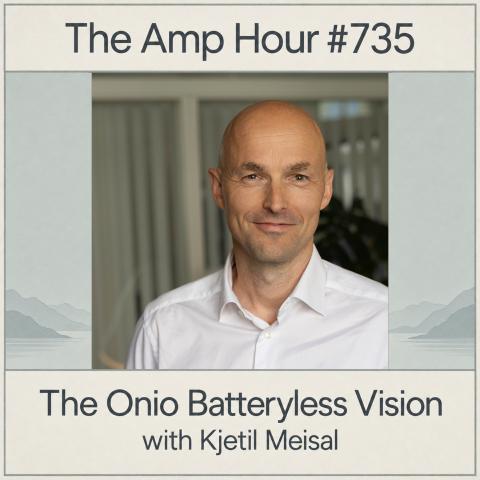
#735 – The Onio Batteryless Vision with Kjetil Meisal
Download episode · 89 MB
Also on Apple · Spotify · YouTube · RSS
Show Notes
Kjetil Meisal, CEO and co-founder of Norwegian semiconductor startup ONiO, joins Chris to discuss the development of ONiO.zero—a revolutionary batteryless microcontroller powered entirely by ambient energy harvesting. They dive into Norway’s rich semiconductor heritage, custom RISC-V architecture, sub-microwatt cold starts, paper-based biofuel cells with BeFC, and making “stick and forget” IoT sensors a reality.
Timeline
- Welcome Kjetil Meisal: Chris welcomes Kjetil Meisal, CEO of ONiO, to discuss their vision for truly batteryless microchips. (00:00:15)
- Stick and Forget: Exploring the core dream of deployment-friendly IoT sensors that run indefinitely on harvested energy without maintenance. (00:02:15)
- Nordic Silicon Heritage: Kjetil highlights Norway’s deep semiconductor roots and ecosystem spanning Oslo and Trondheim. (00:05:00)
- Norwegian Chip Companies: A breakdown of global heavyweights built on Norwegian acquisitions, including Texas Instruments (former Chipcon), Silicon Labs (former Energy Micro), ARM Trondheim (former Faltung), Microchip (Atmel AVR team, discussed on The Amp Hour #633), Nordic Semiconductor, Novelda, and startups like ONiO. (00:07:45)
- The ONiO.zero Platform: Banner specs of the ONiO.zero MCU—a custom RISC-V CPU core, multi-protocol 2.4 GHz radio, power management unit, and multi-domain energy harvesting. (00:13:00)
- Energy Storage Options: Moving from ceramic capacitors and supercapacitors to rechargeable cells under a “batteries not required” philosophy. (00:15:45)
- Going Back to 2016: The origin story of ONiO with co-founders Kjetil Meisal, Runar Finanger, and Vemund Bakken exiting Novelda to solve low-power challenges. (00:19:15)
- From Fever Patches to Silicon: Transitioning from a single-use temperature monitoring patch concept to general-purpose ultra-low-power silicon. (00:22:15)
- Mature Process Nodes and In-House IP: Why ONiO chose a robust, mature silicon node and developed 100% of their IP in-house without third-party licensing. (00:25:00)
- Developer Mental Shift: How clock gating, powered-off blocks, and GCC-based toolchains require firmware developers to think in terms of energy scarcity. (00:27:45)
- Sub-Microwatt Cold Start Sequence: How the Power Management Unit harvests ambient voltage, triggers ultra-low voltage monitoring loops, and safely boots the RISC-V core. (00:30:00)
- Pomegranate Seed Power: Demonstrating extreme low-power operation by booting the chip and transmitting Bluetooth signals off citrus fruits, tomatoes, blueberries, and a single pomegranate seed. (00:32:30)
- Energy Harvesting Sources: Matching ambient indoor light, outdoor solar, Peltier thermal gradients, and RF signals with ultra-efficient silicon. (00:37:00)
- Managing the Energy Reservoir: Transmitting data in bursts, managing duty cycles, and running a wireless thermostat for two weeks on a supercapacitor in total darkness. (00:40:00)
- Custom 2.4 GHz Radio Stage: Achieving -100 dBm sensitivity at 3 mA RX and 0 dBm at 6 mA TX with custom RF integration supporting 5+ protocols. (00:42:30)
- Why RISC-V over ARM?: Why ARM’s licensing fees and instruction restrictions led ONiO to custom RISC-V microarchitecture tweaks, echoing open-architecture discussions on The Amp Hour #637 and The Amp Hour #687. (00:45:30)
- CoreMark & ULPBench Benchmarks: Breaking down ONiO’s 22 µW/MHz efficiency, 4.1 CoreMark/MHz score, and record 180.75 EEMBC ULPMark score. (00:48:30)
- Compute Trade-offs: Balancing clock speed vs. leakage and why continuous low-power computing outweighs raw high-performance processing in IoT. (00:52:00)
- On-Board TinyML and Event Processing: Using lightweight edge signal processing to transmit event triggers rather than continuous raw data streams. (00:54:30)
- Key Application Domains: Deploying batteryless sensors in precision agriculture, smart building infrastructure, asset tracking, and perpetual biosensing (as previously explored on The Amp Hour #733). (00:58:00)
- Biofuel Cells with BeFC: Partnering with French startup BeFC to combine paper-based enzymatic sugar fuel cells with ONiO silicon for compostable tracking tags and skin patches. (01:00:15)
- Customer Engagement & Trade Shows: Partnering with early-access customers, offering QFN packages, and appearing at IFA Berlin, Electronica, GITEX Global, and TechCrunch Disrupt. (01:01:45)
- Sustainable Electronics: Exploring biodegradable PCB substrates, finding ONiO at onio.com, and following their updates on LinkedIn. (01:02:45)
Transcript
Intro announcer: This is the Amp Hour Podcast. Released September 24th, 2026. Episode 735. The ONiO Battery-Less Vision with Kjetil Meisal.
Chris Gammell: Welcome to the Amp Hour. I'm Chris Gammell of Contextual Electronics.
Kjetil Meisal: And I'm Kjetil Meisal, CEO of ONiO.
Chris Gammell: Welcome, Kjetil. How are you doing?
Kjetil Meisal: I'm doing really great. And I got to say thank you very much for inviting me to your podcast. And I hope I can bring some new insights into what we're doing and drop the whale a little bit. So let's see.
Chris Gammell: Great. Yeah, I mean, I've been following... So it's ONiO? How do I say it?
Kjetil Meisal: ONiO. ONiO is perfect.
Chris Gammell: And you're claiming truly battery-less circuits. And I've seen that in the past, but it feels real now. And obviously, because you have stuff in the marketplace. I mean, where are you targeting your chips? And where are you seeing successes?
Kjetil Meisal: Oh, wow. That's a big question. I mean, we are early on in the commercial part of the company. So we're doing that scaling now. But I mean, this is kind of jumping into the middle of the pudding, isn't it? So we started off early on looking at, you know, the true dream of stick and forget in the IoT sphere, right? Sensors that can run forever. And as you said, and kind of pointed to a little bit, it's too good to be true. And we meet that many times in the market. But we have done things that allow us to really make battery-free or battery maintenance-free sensors and interfaces. So we can jump a little bit more into that during the call, right?
Chris Gammell: Every Tarantino film starts in the middle. So why not? You know, we can do that too, right? Yeah, yeah, sure. Yeah, and so your company's based out of Oslo, right? And then there's also just like a Norwegian component, which makes me think like, oh, I know another kind of low-ish power. I think the scale difference is different there. But Norway kind of has this corpus of very, very smart silicon folks. So it seems like more interesting things coming from the Nordic regions.
Kjetil Meisal: Yeah, and I can say a little bit about that. And clearly, we have an ecosystem effect. And it's not kind of coincidence that we are here. So we have some semiconductor heritage that runs deep. And a little bit on the short version, we have some global heavyweights that's built on Norwegian acquisitions. So Texas Instruments is one of those. That's former ChipCon. And TI's low-power Wireless Group is now in Norway. Silicon Labs, which now, of course, also is Texas Instruments. But it was formerly Oslo's Energy Micro. That was acquired in 2013. And then we have ARM in Trondheim, which is a Technical University spin-off up there, which used to be Faltung. And now they're doing the Mali Immortalis GPUs. And then we have Microchip, which was Trondheim's ASIC team in Atmel that co-invented the AVR architecture behind Arduino platform, Arduino platform that we all know. But also we have independent, publicly traded Norwegian chip companies. And the big one in the group is Nordic Semiconductor. We all know them, right? We have also companies like IDX, Biometrics, Next Biometrics, Polite, and so forth. And then we have the smaller, more unknown ones like us, specialized startups and innovators. So it's us, ONiO. And we have Novelda, Crayon Nano, Nanopower, Semiconductor Sensible, Sonar, IDS, and a bunch of others. So there is, I could go on and on with the list, but-
Chris Gammell: I was going to say, there's something I didn't know in there. I mean, that's wild. I mean, is that a university basis? Is it just because of kind of historical basis of other chip groups? I mean, I knew there was a strong semiconductor component up there, but I didn't know there's that many. That's wild.
Kjetil Meisal: Oh, it's a little bit of all. And I mean, we're not a big company. It's close to 6 million people living here and having, I think we have more than 50 semiconductor-related companies in Norway. So that's pretty good. But we're all spread out though.
Chris Gammell: Yeah, that's great. Wow. We're talking about very, very low power. You said ONiO is at the kind of the beginning of the genesis of it all. But that, you know, it's another in the line of like fabulous semiconductors and things like it. So, you know, maybe you could talk a little bit about your, so the Zero is, the ONiO.zero is the name of the product that's out in the marketplace. Is that right? Yeah. So can you tell us kind of like the banner level specs of that and like where you think it shines the most?
Kjetil Meisal: Oh, that would be all over the place. But let's do the kind of the basic wrap up. So it's a fully embedded platform. You have a RISC-V CPU core. You have multi-protocol 2.5 gigahertz radios. You have, of course, all the memories you need. You have a bunch of peripherals. You have a built-in power management system. And you have energy harvesting in multiple channels and domains. And all of these things are built together and built on kind of the idea that you don't have a battery. You have energy harvesting. And you don't know how much energy you will have at any point in time.
Chris Gammell: That's interesting. So, okay, those are really interesting, you know, banner level specs. First off on the energy harvesting side. So no battery, but like super cap, like what is the actual like storage mechanism? Because as you're harvesting energy, you're, you know, you're harvesting, harvesting, harvesting, putting it in a bucket somewhere. What is that bucket?
Kjetil Meisal: Well, yeah, you can go all the way from, from let's say a few ceramic caps and be good with that. But that would entail very little radio communication and typical advertisement mode. But then you can also move all the way through super caps as you, as you pointed to supporting more and also supporting things like if you're light powered, you support the dark periods over a weekend or a week or a month, depending on how you design it. And you can go all the way to rechargeable batteries or even traditional batteries. The key point in all of this is that we are much lower power than what exists in the market. So we can either give you a zero maintenance device where you have rechargeable batteries or super caps or caps that runs forever on energy harvesting and maintain its own power system. Or you can go to traditional batteries, which we also support, and you get a lot longer battery lifetime. Multiple times, not percentages. So batteries are allowed, just not required. Exactly. Batteries not required. That's a little bit of a punchline that we have. And I think that we shouldn't kind of say that batteries are not going to be there. They are in some applications. And even though you use batteries, it can be sustainable in some way because we can reduce the amount of batteries ending up in the trash if we stretch the battery lifetime. But we come to a point where it doesn't make sense anymore to use a battery because you don't have to. Right? And then increasing the lifetime of the product and kind of the total lifetime economics and impact is a completely different world.
Chris Gammell: Yeah. So this actually is a good kind of like, I'd like to go back to kind of the origin story here too because so I work kind of broadly in the IoT industry and I feel like users ask for this sort of thing. But like when you really get down to it, you're like, well, you know, you can only send X amount of data every so often. And, you know, you have to have all this, you know, supporting stuff. Obviously now contained within the Xero chipset, like energy harvesting and all the tough things are in there. They kind of go, ah, you know, we'll just add a big battery and we'll be done with it, right? It doesn't have to be as small as we thought. So like, so how did you kind of come around to this idea in the first place? And who was asking for this at the lowest, lowest end? Because from what I've seen on your website, you know, looking at like, like, it's the ESL, right? It's always confusing one for me because it's ESL is electronic store labels is one of the ones that you show. But then ESL is also English as a second language. So I always kind of confuse those two. And then, and then like just general IoT sensors. Those are two like kind of classes of things that you have on the website. Was that kind of the genesis of it? Or where did it all start there?
Kjetil Meisal: Oh, we're going to go way back now. So, so let's, let's, let's do that. So it started in 2016. And I exited Novelda at that time, the company I helped build since 2005. And it was a, so it was a combination of things. I would say it was a joint frustration at the lack of major leaps in low power design outside of universities, which seldomly become an industrial thing. And combined with the kind of targeting single chip system integration and thinking about sustainability and full life cycle before, I mean, even starting to design the chip. So we, we, we, all our, us three founders. So it's me, Runar Finanger, which is CMO and Vemund Bakken, which is our CTO in the company. So we are the founder group and we, we all had small children at that point of time. And we, we saw the annoying factor of fever monitoring, temperature monitoring in humans. So I said, so what, what, what would it take to make something that's easy, stick and forget for continuous monitoring of temperature in, in humans? And started looking at a lot of different technologies. And of course, the more you think about it, the more you kind of work around it, you see that this technology really, it doesn't exist because somebody hasn't taken that leap of low power design, integrating every tool you need to make it into a single chip, right? And then of course, we also saw that you can't have a battery in this system because you need to be able to throw it in the garbage. It's going to be a single use thing that you throw away and you don't want to have that impact around you, right? And we said, okay, we come from the semiconductor world, we can make this chip. So that was kind of the high level specifications. It was a stick, stick and forget skin patch with wireless communication, temperature sensing that was accurate. And of course, processing, energy harvesting, you'd need that too. And zero dependency on batteries. And the possibility to build this with minimum amount of components and throw it in the trash.
Chris Gammell: Was there an aspect of like, how hard could it be in there? Did I hear that?
Kjetil Meisal: Did I hear just that flavor of it? Or? Yeah, we're like, I would say we like terrible challenges, but it's, no, no, but I mean, you're an engineer. So if people tell you that things are impossible, do you start thinking, right? That's why hasn't anyone done this before? Well, nothing is impossible. It just takes a little bit longer time. So looking, starting to look at kind of concept in everything from computation to power management to radios and everything. So that, well, this is possible. We can do this. And then of course, if you look at the business side of things as well, if you manage to make this, the market is enormous. It's extreme. It will outcompete anything else in the edge that is doing sensors and continuous ILT, information gathering, processing interfaces in all markets. It's the dream of ILT, the stick and forget experience, right? Without the battery. So then it wasn't just a temperature sensor and a bandage anymore. It was much bigger than that. So we dropped that idea of doing kind of looking at the end product and started focusing on the semiconductor. And from there, we have met customers turned partners in joint technology that will really, really allow us to go into the medical and health space actually doing these type of sensors. So that's an interesting journey we're looking on and years to go.
Chris Gammell: And additional challenges in the medical space, of course, as well. But I mean, if you have this baseline technology like contained within the chip, then you, then it's like, okay, well now add whatever you, add whatever flavor you'd like and take advantage of the power and the harvesting and all that other stuff.
Kjetil Meisal: Definitely. And I mean, you have, you have aspects, health is one thing or medical device is one thing, but you have health applications as well and proactive healthcare. So proactive healthcare, sorry. And that is becoming more and more important. We're becoming more and more people on earth and less and less people working in healthcare and more and more old people, less and less young people. So we need, we need sensors. We need technology to help us.
Chris Gammell: What about, what about the effects of like, so you said you started in 2016. I mean, just thinking about process nodes back then versus now, you know, like what was available? Did you, you know, like the, that's a, that's a long journey. Was there additional benefits of this kind of taking a little bit longer, developing your customer base, developing your, your, your product on top of a process? Did that end up helping or hurting kind of in the, in the, the overall?
Kjetil Meisal: I don't really have a clear answer to that. It's, I mean, we made a conscious choice. We looked at different things that was available. One thing that, that you need to look at if you do these things is something that will be available for a long time. Something that is robust and well-developed when you start using it. I mean, building a whole chip with a small team, all IP in-house is one thing. You don't need to compound risk on having some new process and some fancy thing that is not tested thoroughly through, right? So, so doing that, it was a very, very conscious choice and a balance in between everything from performance and cost to matureness and tools.
Chris Gammell: And so, and, and truly like bottom up, you didn't license any like radio, I mean, core, obviously it's a RISC-V, you built your own core. Yeah. It's interesting. In-house, in-house IP. That's awesome. I mean, that's, I got to say, probably when you're, when you're going to talk to, you know, Sand Hill Road and other VCs too, you're like, no, no, we own all of it. Like that's, that's a nice dependency that you can just check off and be like, nah, don't worry about, don't worry about the licensing.
Kjetil Meisal: That's good. Exactly. Exactly. And I mean, again, too good to be true, right? That is also one thing that, that really wakes people up a little bit is that we actually own all IP. We control all IP. Yeah. There is no, no competitor can go to a third pipe IP vendor and say, I want the same as these guys. Doesn't exist. We have it.
Chris Gammell: That's interesting also though, because, you know, I think like my, my business side of my brain is like, that's, that's good and that's smart and that's probably worth spending the time on. The engineer side of my brain says, oh, wait a second though, are there software compatibility type things where now I, you know, me as a developer, I have to go and like build a custom stack against it or compiler support and all that other stuff. So, so how does that then start to play in there? Like, is it, is it so for, like, just to use a bad example, like, I really love, always loved the idea of like the, the parallax controller, but it was like so foreign to me, like having like eight cogs that are like mini processors in there that it like was almost detrimental. So like, is, is there any of that in there?
Kjetil Meisal: To put it this way, we spend a lot of time kind of defining what would be important to get this chip into mass market. And that was everything from the production and business and cogs side of things to easy to use factor in everything from testing to developing to infield updates and all of that. Of course, the features and low power numbers, it all needs to be there because if you bring something to market that is extremely terrible to, to implement, you're going to have a challenge, right? Oh, so we, we paid a lot of effort into that and we, we, we, of course, it's, it's not, as you probably understand, the tool chain is, it's not a standard RISC-V. So it's on your zone, but it's based on GCC. So that's, it's going to be familiar in many ways, but there are, there are a few things that you, that you kind of need to think about a little bit. I would say that as a, as a firmware developer, there are parts of the chips that kind of can be stopped, they're clock gated and, and Amy, even, even fully powered off to reduce residual leakage. So there is a mental shift kind of in, in how you need to think. You need to think low power. It's not a battery that's there at all time, right? Yeah. So, so you, you have a little bit of different thinking going on. So I, I think that the mental shift is, is tracking what's actually available or powered at any given moment and knowing what needs to be reconfigured when you're waking up from, let's say, deep, deep sleep mode. You can't assume that stays persist the way it would coming out of a shallow sleep, right? So that, I would say that becomes more important.
Chris Gammell: That's interesting. Also interesting in like the age of the LLM and coding tools, like some of this stuff that like, I think we still need to keep a lot of that in our heads and, you know, like have a mental model of where all this stuff exists, but then, you know, throw the clanker in the mix and, you know, Claude might be better at, you know, knowing what to switch on and off and digging deep in the data sheet, that sort of thing as well. So there's, there is like an interesting kind of X factor there too. Yeah.
Kjetil Meisal: Yeah. There is definitely an X factor there. We will, we will come to that at a later time and we will also release stuff to the public. So, yeah, it will become available.
Chris Gammell: That's interesting about the clock gating. Does that mean then that you have to have like, so there's no like a NVRAM or anything like kind of odd like that. It's just writes stuff into like Flash as it needs when it goes into deep sleep. I mean, Flash being its own kind of, not energy hog, but, you know, somewhat power expensive operation.
Kjetil Meisal: So, I mean, we have, we have multiple things built into the chip that you, that you can use at all time. I mean, we have Flash, we have RAM, we have ROM. There is a way to kind of use it all, but I mean, you're pointing to what happens when you, when you kind of wake up. Is that a...
Chris Gammell: Yeah, yeah. Like when you're, when you're coming up out of deep sleep, you said like kind of the, you might be gated. So like the serial peripheral is not there because that's an energy hog. Okay, fine. That's turned off. But if there's some kind of operational code needed to control some downline peripheral, does that need to be stored in a part of Flash as part of the sleep mode, that sort of thing? Like, like how much of it is just the CPU doing its thing and talking to peripherals? Are there, are there actual like, like kind of shut down procedures and wake up procedures that are required to sequence things back up as well?
Kjetil Meisal: Okay. So, so let me, let me walk you through a little bit on what happens like the first millisecond of, of a cold start, which as you probably have seen on a spec is less than a micro watt. So first thing is that the power management unit, it, it starts up immediately and it tries to harvest energy from whatever source are connected, right? And we can harvest weak voltage sources, oscillating signals, which can be RF. You can have solar, you can have PISO, you can have thermal elements connected. And, and it starts storing it in, in, in the main energy reservoir. And then the second we have enough voltage to run the ultra low voltage digital logic. So it's a combination of a lot of tricks in the book here. The logic starts a monitoring loop and then it waits until the kind of main reservoir crosses a programmable threshold. So, then once that level is reached, the main supply rails, IO and digital logic are generated. And only then the main CPU starts. So this happens quickly, of course, and it's using then a low frequency internal oscillator to keep startup energy at the very minimum. Great. Yeah. So you have a combination of, in memory, you have a combination of things. So some things are in flash, some things are in ROM, and it's all kind of placed in such a way that it's power optimized for a startup and sleep power.
Chris Gammell: And actually, there's a really good video that you have on your site where it's showing like a e-paper display with a really, really tiny solar panel. And then it's basically like someone, maybe, I don't know who, it's just a set of hands, so whoever it is, very nice hands, great hands. And it's basically just like waiting for that charge to happen. So that is, I think that's a good example of like, okay, you have ambient light, super low voltages on the super low power output from that tiny solar panel, solar cell. And then once it hits the threshold, then it can go and update the screen and do all the things that it needs to do. Then it goes back into deep sleep and the cycle can start again, that sort of thing.
Kjetil Meisal: Yeah, we have started posting or we have posted over a long time several videos kind of trying to show off the low power and harvesting features. It's not always easy to get people to understand, but one of those, one series is that we did early on and you're probably very familiar with the kind of the old potato clocks that you could build, right? Connect together a few citrus fruit or potatoes. So we did that powering up the chip and sending advertisements on Bluetooth blinking LED and so forth. So we started up doing kind of the bigger things. I think we did an apple or something in the beginning and then we asked on social media what people wanted to see and then it went, of course, smaller and smaller and smaller and we went to a grape, we went to a small cherry tomato, we went to a blueberry and I think the last thing we did powering up everything very quickly was one pomegranate seed.
Chris Gammell: Wow.
Kjetil Meisal: And it powers up the whole system and runs. So that's just a little bit about the low power features that you need as well.
Chris Gammell: See, here's the problem though. Like, I remember doing these things in like science class back in my much younger days and then someone being like, we could start a company with like lemon power and like for a long time it has not been possible but now, I don't know, I think this is problematic. It's going to enable the lemon companies of the world, I think. I don't know. Yeah.
Kjetil Meisal: About bringing back the good old days in marketing communication, right? It's, we need to have a little bit of fun as well while we're doing this. Yes.
Chris Gammell: Yes. You do have very, very brash, very fun marketing. Yeah. It's good. Thank you. It's good in the, you know, I don't think chip companies are normally known for being super wacky and I wouldn't say you're wacky but it is, it's fun. It's got some fun stuff in there. So that's good.
Kjetil Meisal: Appreciate it. I'll forward that to the marketing department.
Chris Gammell: Yeah. Tell them the tip of the hat and then I send them my regards. Yes. Thank you. I mean, this is really interesting too because I've always, so you said like the vibratory harvesting as well. I mean, again, like just, just thinking about like someone looking myself, others looking at things like, oh, look at that Peltier can, you know, that Peltier there and it's like, oh, you have a temperature differential and like I could like harvest energy from that and the answer is, well, nah, not really but maybe now, yes, there is more possibility there. So, I mean, just from early interest, early, early access, early customers, what are the power sources that are, are most reliable and people are kind of moving towards? Is it solar usually? I mean, like even indoor solar?
Kjetil Meisal: Yeah, let me first point to one thing that you noticed as well and that we saw early on that's very, very important to understand and that's that you have energy harvesting sources. Yes, you have indoor solar. You haven't, I mean, calculators since the 80s, right? And, or maybe even earlier and you have the Peltier elements, you have all of these things, even just an antenna, right? can harvest energy with a rectifier. But if you combine that with the existing technology that's been out there on the market, it hasn't been enough. You would still need a battery. You would still need a huge rechargeable battery to start up, to run, to operate safely and kind of be there. And that's kind of a little bit of the threshold that we have crossed with our technology. We consume so little and we harvest so efficiently on the electronic side that the combination of existing harvesting technology is a really, really good match. And I wouldn't say that there are just one good one. It all depends on application you're trying to power, right? Is it temperature differences and complete darkness or is it indoor application? Is it outdoor? Is it precision agriculture? I mean, of course, it's hard to beat light. It's really hard to beat sunlight, for instance, outdoor. But you need to cater to the nights. You need to have a super cap, right? So you can be powered during night as well. Unless the application allows you not to. That could be also done.
Chris Gammell: And I think managing not customer expectations, but just, you know, like all things are trade-offs, right? This being, it sounds like the sequencing and the, you know, the magic sauce is definitely the, is the low power first mindset and the capabilities like the sequencing you mentioned. But then also like the, well, you're not going to be transmitting, you know, for kilometers, you know, sort of thing. It's like realistic power outputs and, and, and, and, okay, maybe not even power outputs. How about like, how often you can send, right? Just there is a bucket of charge. We have however much charge we can put towards our radio and things like it. People can't see this, but Shetel's actually giving me a look like you're crazy, Chris. So please, please explain. I mean,
Kjetil Meisal: we, we do have kind of standard multi-protocol 2.4 gigahertz radios. And, and I mean, yes, if you have a super cap, you can really transmit for very long. You can use code to optimize range and you can use all the normal tools that you have in the different protocols that you're familiar with in the low power sphere. Depending on your duty cycle, of course, you can send long. You can, or over a longer range. But you can also send less data much more frequently. And it's the same effort almost. You have, you have a threshold though. So you have a bucket, as you say, let's call it the bucket, the reservoir that you fill up at all times with energy harvesting. So you can't at an average take out more than you fill in, right? Because then you'll deplete it. But you can do that in bursts.
Chris Gammell: Right. And especially in that nighttime, daytime example you gave as a great example, like fill up the bucket during the day, take some sips at night, make it through the night sort of thing.
Kjetil Meisal: That's easy to understand, right? Yeah. But to put it, to put these things a little bit in perspective, we do have, we do have applications where you have a thermostat design doing temperature and air humidity. It transmits data every two minutes. We have a super cap on the design. And I think that lasts for two weeks if you cut the solar cell when it's fully charged. So that's, that's a little bit about the capabilities of just adding a small super cap what you can do. That's wireless communication.
Chris Gammell: And so you said multi-protocol as well, 2.4 gigahertz. It makes sense. So first off on the silicon side, was there, it's fully custom on that side as well. Were there like huge efficiency gains from doing fully custom as well? I mean like outsized from like, you know, other Bluetooth chips I might have around?
Kjetil Meisal: Yes, I would definitely say so. And I mean, if you, if you look a little bit on our features on the radio side there, we, we have a zero dBm at around six milliwatts and, and RX at three milliwatts. and we achieve minus 100 dBm on that. It would not be possible if we did off the shelf third party radio as we see it. And also, I mean, doing the full integration in the whole system of the chip with the CPU and power management system and the radio wake up features as well built into this is part of kind of how you can achieve low power, wake up, transmit, go to sleep or listen kind of features. Okay. So definitely the custom radio is part of it.
Chris Gammell: Sometimes we have just physics standing in our way, right? It's just like, you know, tugging, tugging on the fabrics of the universe and magnetics and electronics interacting. But yeah, I do, it is interesting that you're able to get additional, additional, you know, efficiency gains from the custom stages and stuff like it.
Kjetil Meisal: Yeah. We're pointing a little bit to your answer early on. So what's the, what's kind of the secret sauce, whatever you've done that's so special and it's, it's, it's hard to answer quickly because it's all over the place. I mean, it's in everything. That's why we had to tailor everything as well because we had to think differently. There is no battery. We can't think that there is a battery available at all time.
Chris Gammell: So even with these efficiencies, you have multi-protocol, Bluetooth LE, you're not doing like Bluetooth audio or anything like that, but like Bluetooth LE, but then like Ant and other low power 2.4 giga, it's like packet radio style comms and things like that.
Kjetil Meisal: I want to, I want to be, I want to be careful about mentioning actual protocols right now because it's all about licensing before you market them. I see. So, or certifying, sorry, certifying them before marketing them. I see. So that's why I'm not mentioning names, but to put it this way, we cover at least five protocols in the 2.4 gigahertz low power space.
Chris Gammell: If you have a 2.4 gigahertz radio and people can access registers as well, they can implement their own if they really wanted to. So, yeah, and, you know, some wacky ones will.
Kjetil Meisal: Oh,
Chris Gammell: definitely. That's possible. I'd love to go back to the RISC-V thing. First off, just given your timing, you know, so like you started in 2016, RISC-V wasn't a thing then. So when did you make that mental leap to, you know, decide on a RISC-V architecture, you know, building your own, your own processor on top of the ISA, which we tried to disambiguate a lot on this show before because it's like, oh, for a long time, how about this? Historical note, for a long time, the Empire were like, oh, open source processor. And then people kept writing in. They're like, no, Chris, that's not it. Please read the documentation. And finally we did. So you had your own custom design on top of the instruction set architecture, but did you have to do modification applications within, you know, custom commands and other things to help improve the efficiency from a processing perspective as well?
Kjetil Meisal: Yeah, you're digging really deep now. And I would like to also go back a little bit on the RISC-V versus ARM. And there is a little bit of reason why we selected RISC-V. to put it bluntly, ARM doesn't allow you to do real deep modification. We wouldn't get the instruction set and write our own CPU, right? I think it's one or two companies in the world that gets that access and we're not one of them, to put it that way. And it's very, very, very expensive. So we felt that building things customly or having to modify things and also that would not be an ARM go-to. And then also we don't like paying license fees to companies with things that don't have the exact thing we need. So therefore, the decision was fairly easy. And our team and especially the main guy behind the RISC-V architecture knew that from before and was already deep into the mud on the RISC-V. And yeah, we've done some magic on that side as well. And it's power savings that come from if we're going to dig into that from kind of micro architecture and design flow choices that's layered on top of the standard RISC-V itself.
Chris Gammell: I imagine like there was a bar chart as you were doing early architecture type things. You're like pointing at like radio instruction, like pipelining in the CPU and things like, like things that were just like huge power drop efficiencies to be had. And I'm sure one of them was just like, yeah, make this CPU different and it'll be better.
Kjetil Meisal: Yeah, I can walk you a little bit through a little list of things here. So, I mean, first of all, we have the 16-bit compressed instruction support. So meaning fewer fetch cycles and less energy per instruction. It's an instruction cache. So fewer access to flash memory. So that's also very important. A careful design pipeline. So only the data path that you need for any given instruction type is activated. Then you have a custom register file design, which is something you wouldn't get anywhere else. So meaning that we do lower energy than a standard flip-flop based register file. Then we have branch prediction, more instructions, retired pro clock cycle, I would say, and then support for bit manipulation instructions. So fewer instructions needed for typical microcontroller style data manipulations. A design flow where every change is vetted through a synthesis, place and roots, power estimation iteration. We have a compiler with optimization specifically tuned for code size efficiency on this core. So it's not the easiest thing to build, but it's well thought through. And you see that on kind of the ultra-low power score and kind of how it dominates in that area, which was very fun when we first released the results. And this is, we released the results two years ago now. And that's a three-generation old chip.
Chris Gammell: Oh, wow.
Kjetil Meisal: Okay. Yeah. So we've already gone past that as well.
Chris Gammell: Let's see. Oh, I see. Sorry. You meant that there had been two prior to it. So it is a third generation,
Kjetil Meisal: not there's been three centuries. No, no, no. We have moved forward after that, of course. So that's three generations old, or we have moved three generations away from that. Wow.
Chris Gammell: Yeah.
Kjetil Meisal: Yeah. So, and I mean, you can, if you look at the CoreMark score, and this is, of course, only the compute part of the system, which is important when you do compute. But when you don't, sleep is more important, right? When you do radio, radio is more important. And then management of everything, then power management is more important, right? So you always have these things. But if you focus on the compute part now, so we do 22 microwatts per megahertz. I'm not sure if you've seen the CoreMark score. I didn't really know what I was looking at. I'll be honest. Okay, okay. So let me, let's break it down a little bit for you. So when you do the test, there are certain rules that you need to follow, and you need to use a certain hardware to test. You need to use a certain software to test. So it's not like we can define things ourselves, which is kind of part of the point. We should all be compared on an equal basis, right?
Chris Gammell: Yeah.
Kjetil Meisal: So you have two kind of main things, I would say. We did the CoreMark score, energy score setup. And that gives us some power efficiency matrixes of 4.1 CoreMark per megahertz, which is, I mean, if you compare it to the typical best-in-class competitor, they are at 2 to 3.5. So that means, in all practical sense, that we get more mathematical compute done per clock cycle than standard ARM Cortex M0 or M4 architectures. So we beat them. And then also...
Chris Gammell: Like apples to apples, like same process node as well?
Kjetil Meisal: No, that doesn't really matter in that context, right? It's energy per... Or compute per energy. And per clock cycle. I would just think,
Chris Gammell: like when you move down a process node, don't you end up having like kind of just natural built, you know, like Moore's law style like benefits? It's...
Kjetil Meisal: You also increase your leakage, right? So it's not always. And I mean, if you also do that to increase your clock speed, you also lose efficiency. So it's always a sweet balance. And then if you look at the ULPMark energy score, we are at 180.75 with a peak of 181. And if you look at the typical Western class competitors there, we are seeing 100 to 150 in average ULPs. So that means that we execute more full computational loops per unit of energy than a majority of standard industrial MCUs out there.
Chris Gammell: And ULP is like ultra low power, some kind of measure, like CoreMark. CoreMark's like a general like CPU comparison engine, right?
Kjetil Meisal: Exactly. It's kind of where we do the pissing contest on who's best. And it's defined on how you do it. This was kind of fun for us as well because we wanted to show off a little bit of what we can do. And the CPU as that is just one part of the system. It was a little bit interesting to go out there and do that because it didn't reveal a lot more. But still, if you look at the list, it's almost, I haven't seen another RISC-V CPU on the list. It's only ARM architectures. So we were the first RISC-V to hit the ULPMark score list and we took first place on our first try. And that's two years ago.
Chris Gammell: Yeah, that's great actually.
Kjetil Meisal: And we're still there.
Chris Gammell: Right, exactly, exactly. I mean, I think it's, some of it, I feel like with ARM kind of dominating on that list too, it's like ARM has lots of engineers building on their cores and optimizing and things like it. And now you're just a tiny team, but also doing the same thing as experts. So that is very impressive. What are you giving up with these efficiencies? I mean, so some of it is you have architectural differences that are improving these scores, improving just the overall efficiencies, kind of that singular focus on power efficiency. But there must be something that's being given up in terms of processing, time, throughput, like reactivity. It could just be like you're not targeting certain applications that need super high performance. Exactly. What is the piece I'm missing?
Kjetil Meisal: Yeah, but that's true. And there is always a trade-off, right? We as engineers, we know that you're paying some way. So the thing is that if you look at, let's say, Cortex M5 and up, they perform more, so they can compute more, right? It's a different architecture, different setup, but they're also targeting completely different applications. They're not exactly super low power. For us and for the markets that we wanted to kind of achieve with a stick-and-forget experience in all of IoT, everything from medical and health to industrial to a lot of other applications we can talk a little bit about, you don't need that much processing power. You need low power processing. And sometimes you even have quite a lot of time to process. So you need something that can take that into account as well and say that, I mean, the traditional way of computing low power is finish up quickly and go to sleep, right? Yeah. Doesn't necessarily have to be the best way to do it. You can say that, well, let's do it really slow. Maybe that's better.
Chris Gammell: Right, exactly. And that is interesting on the application side too. Like, you know, just not to point it a competitor part, but like I have a lot of like NRF 52 840s now, like very long in the tooth, eight, 10 years ago part, still a good part. But that thing's got like a floating point unit and like that can go like all the way up here and it, you know, it operates in a low power and it does audio and it does USB and like all of these things. So it is kind of like this, the every man part, like that I'm targeting. I could point it at a bunch of different things, but it does sound like this is saying, okay, we're targeting that lowest end and that being a application space and a thing that's so ubiquitous once you take the battery out of it that that really starts to be the, you know, that's the thing, the singular focus into that ultra, ultra, ultra low power.
Kjetil Meisal: Yeah, and that's kind of the core thing here. We're targeting the batteries not required, as we mentioned earlier, a sphere of things. And that entails energy harvesting, super low power or a very long battery lifetime. So then you need to be scared with your energy.
Chris Gammell: If before I was worried about people looking at lemons and grapes and pomegranate seeds and saying, oh, we can build a whole company around this. Now the problem is the other side where people say, look at this incredibly low power thing. I'm going to do AI with it. He's like, whoa, whoa, whoa, whoa, whoa. We're not putting LLMs on here. Don't worry, just go over there. There's stuff over there. That's fine. Stick and forget. And this is the more interesting space that is there.
Kjetil Meisal: You are putting something that, well, yeah. So, I mean, we've built in quite a lot of things. So I'm not going to pull the whale completely away. But so let's, if you look at the edge, the very far edge of things in the market, what's very important there is, of course, low power. Zero maintenance is very important because you want to kind of have things that operate and give you data over a long period of time. And to achieve low power and zero maintenance, AI or machine learning ways of single processing is actually pretty important. to do simple stuff like catchphrases, vibration patterns and predictive maintenance, sensor patterns, things like that. We want to send a notification of an event rather than raw data to a data center, right? That's what we want. That's what we want. We don't want you as sensors to send data at all time. We want to send data when it's important.
Chris Gammell: Okay. So you're saying like a tiny ML style processing on board, whereas maybe that bucket that was going towards the radio, now it's going towards a, you know, a Mac that's running, you know, some kind of waiting system in there. Something like that. Okay. So I am interested in getting back to the application space as well, because I do feel one, one, I think that helps the listeners to just be like, where, where can, where can I use this? Right. I think the stick and forget, like the, the, the ones you've listed are, are good. Uh, where, where else are you, are you personally interested in and seeing it going? I mean, because, um, you know, there, there are always these trade-offs. There are going to be some that fit, some that don't. Um, what are you excited about in that, in that space?
Kjetil Meisal: So, uh, I'm excited about a lot of things. Uh, but, uh, and, and I see opportunities in. A lot of different spaces, um, to, to kind of make the world around us a little bit better. Uh, so let, let, let's go back a little bit to, to kind of look at why we do things, why we do ultra low power, why we do IOT and AI. And, and I think it serves a single purpose and that's capture deep insights from our environment, uh, and to do, and by doing so that we can automate and optimize complex systems with minimal energy expense and maximum operating impact. Uh, and in the same sense, save human effort and drastically protects, uh, uh, nature and our scarce global resources. It's kind of, you know, all of that sphere. And, and I think that an excellent example in this sense, and not that that is our main focus, it's one of the things we can do is agriculture because it's easy to understand, right? Uh, it would, uh, it would, uh, show a little bit more on the context side as it's the single biggest impact humans have on nature by far. And it's easy to understand because you want to create the most amount of healthy food with minimal resources and impact on nature. That's what you want to do. And to do this, you need data, you need the data from the field. And I mean, uh, today agriculture has kind of moved or, or developed very far compared to what we were used to. Uh, we have large open field agriculture. We have vertical farming, farming inside of cities and all these things need sensors to optimize the production.
Chris Gammell: Targeted soil, moisture, fertilizer, all that stuff, you know, prevents burn off. Exactly. It feels like a good one. Although I will say my, my limited experience with agriculture is it's a, it's an incredibly difficult market just because of things that y'all are solving for power, um, connectivity. I think harsh environment is probably one of the big ones as well.
Kjetil Meisal: Uh, well, yeah, yes. Um, yes, of course. But if you look at, uh, so if you look at kind of electronics, uh, being affected by, by environment, moisture is the worst, worst for electronics. Right. But if you don't have to switch or charge a battery, right. It's no battery case. Then you can seal it.
Chris Gammell: That is completely. Plastic lip it.
Kjetil Meisal: Exactly. Exactly. You don't need that. That's true. So you can make it pretty ruggedized. But if we move away from agriculture, the, the ULP markets, um, and, uh, and the places where we really kind of see things happening is first of all, you have smart home infrastructure. So prop tech and I mean, temperature and just air humidity and simple sensors can do a massive difference. We have industrial and smart logistics, that's asset trackers. So imagine asset trackers that last forever or asset trackers that last for a limited amount of time that is built in such a way that you can throw them in normal garbage. Uh, and, uh, we're, yeah, I'm coming back to that, uh, a company we're working with on that sense. Um, but, uh, here you can see that you can deploy thousands of sensors. Uh, and if you're want something to live forever and, uh, or if you want something to be on goods or devices in a supply chain to run around, if you have, uh, you usually have, if you're a big player, millions of devices, you, you get a pretty bad operational nightmare in switching batteries.
Chris Gammell: Right. Yes. From a single use kind of perspective too, like you don't want to be chucking even alkalines at in volume into the trash, you know, like something that might be single use, slow use, that sort of thing.
Kjetil Meisal: You don't want to, I mean, today we have 28 billion batteries ending up in landfills and, uh, it's, uh, we, we could work on reducing that rather than increasing it. Another thing is smart healthcare and wearables. That is big. Uh, and not just medical devices, but also health products. Uh, glucose monitors is a, is a very known, uh, product in the market in that sense. Uh, where it started out as a medical device and then it's also moved into health. So people use it to kind of better their diets and life, uh, which is a good thing. Um, and then, uh, talking about that and energy harvesting and, uh, kind of making devices with electronics that you can throw into the garbage with kind of a better state of mind than thinking you're throwing batteries away. We started out working with a company called, uh, BeFC in France, uh, bio enzymatic fuel cells is kind of their expertise. So this is enzymes eating sugar generating power. So it's a paper based fuel cell.
Chris Gammell: Cool.
Kjetil Meisal: Yeah, it is cool. And it's a paper based fuel cell that matches perfectly with our technology. And here you can think you can build supply chain trackers because you have the power source in the fuel cell. You have our chip with the whole electronic system and you can put it on paper. And then you can build things that are put on cardboard that you can just throw in normal garbage. You will have one piece of silicon. That's kind of the non-sustainable part and some metal wires, but that's it. Uh, and then if you talk about skin patches that we talked about when we started the company, now we're opening that possibility as well, because now you can have a small reservoir of sugar water. That is your power source. And you can have a stick and forget continuous monitoring device that you can with good conscience throw in normal garbage when it's done.
Chris Gammell: Yeah. I mean, this is starting to get into like, uh, some serious sci-fi style things too, right? This is like the, the stuff we were promised for all these years, but it's, uh, it has not been there. Uh, and that is, uh, yeah, it's really interesting.
Kjetil Meisal: Isn't that the engineering dream make science fiction science fact? That's right. Exactly. Yeah, no, but, but it is, I mean, we were seeing more and more of this possibilities, not just with our technology, but what we open up together with the technology. Uh, together with our partners as well, uh, with technologies that are unique in themselves, but also combined. Uh, this goes to the low power space. It goes to the harvesting space. It goes to the sensor space and all over the place.
Chris Gammell: Uh, I feel like my internal firmware engineer right now, which is a small part of me, uh, mostly hardware engineer in here. Uh, the internal firmware engineer is like, Chris, ask about the, ask you about the software and the firmware. What are you doing? Uh, so, you know, you'd mentioned like the custom compiler and custom, you know, some, some of the tool chains that are GCC and things like it. I mean, uh, one of the things that when I was first, uh, came upon your company is what I was really doing is I was like, oh, is there a Zephyr port for this thing? I didn't, I didn't see that. That could have just been early days, that sort of thing. So like, how, how do you find that your developers are interacting with your parts in terms of tool chains and software stacks and our tosses if, if necessary, that sort of thing. Yeah.
Kjetil Meisal: So, uh, let me, let me just, uh, drop the whale a little bit on, on kind of where we are and how we're working with customers in the market right now. So, uh, we are, we're kind of not on the mass adoption journey right now. We're transitioning to that, but we're working close with kind of key, key customers and partners and providing them with tools needed to, to develop and, and, and, uh, and, and, uh, and we work close with them also to gain experience on how our tools are working and so forth. So that's kind of the classical approach. You have SDK, you have dev tools, you have evaluation hardware, targeted their application and so forth. So, so that's a little bit how we work. I mean, you can use your normal tools, uh, that you're used to mostly at least. Um, and then with our kind of own sphere of things with, uh, uh, with a GCC based stuff. Okay.
Chris Gammell: And I mean, I was prior to this, I was kind of thinking about like, okay, well, I, you know, there's no purchase parts link on your site, right? There is a, you know, talk to us sort of like sort of thing. And, and that's totally understood. I was, what I was really doing is I was mapping it. If I was on the same path as you were, right. It is incredibly hard to get someone to start from scratch and be like, Hey, we have a new part, you know, design it into whatever and start from zero up. Right. So instead it's like top down, talk to a couple of big clients, work with them, partner with them, that sort of thing. Try and get hundreds of thousands, millions of sales. And then you build this product that, you know, the biggest folks want, and then you could then go into the mass market. This is me mapping it. You know, I'm not trying to say I understand it. I'm just saying I get it. Um, and, uh, yeah, so no, no, no problems for me. You know what I mean? I'm still interested. Uh, I think what I'm really is I'm jealous. Uh, so, so I, I'm, I'm curious how I, how do I, how do I get it? How do I get access to this stuff? I think people listening as well.
Kjetil Meisal: The, the short story here is, uh, we, we, we have production ready silicon. Uh, and I mean, we have a few package offering something. So 40 pins, five by five mill and a QFN, so QFN 40 and QFN 68. So typical the 68 is where you need a lot of IO, for instance, a keyboard and things like that. So we can do full keyboard power by indoor light, uh, without the need of a battery. Um, and, uh, we do have dev kits. We do have samples. We do have evaluation boards. We do have SDK downloads, but again, only available under customer agreements for key customers and partners. Yeah. And this is kind of the key. Uh, I wish I could release it to everyone tomorrow, but we do not have enough resources to do the support in a good way. And I don't want to leave our customers waiting forever for a reply, uh, more than we already do with stretch resources in the company. Right. So we, uh, we work with customers of different sizes and, uh, we try to engage where there is, where we see a real fit very early on and where there is real commitment. And that's kind of where we need to work at this stage.
Chris Gammell: Um, people listening, you know, some people listening are at, you know, I'm sure fortune 10 companies and well, I like to think so. Who knows? Uh, they don't talk to me if they, if they are, you reach out. If you, if you're at a fortune 10 company, the empire wants to know. Uh, but you know, some people are there, some people are sitting in their basement, you know, just hacking on stuff. There, there is all that stuff. And I, I, one thing I always think about is kind of being downstream from a lot of the, the big company stuff, right? I'm not getting early access to Silicon or whatever, but I am benefiting from all of this stuff being battle tested. And so that when hardware dummy like me experiences it, it's like, oh, actually this has been tried by, you know, tens to hundreds of FAs and customers and everything else too. So like that there, there are benefits from being down the line a little bit. Yeah.
Kjetil Meisal: We want the experience to be really good when, when kind of everyone gets access to it. Uh, so that, that's why we want to have some skin in the game and we want the customer to have some skin in the game now that we are kind of working out, uh, the first big products coming to market. But that said, um, we could do a lot more, uh, with more resources to scale. So you said, uh, I mean, building this from Norway, there is one caveat in that, and, uh, there is less capital available than in Silicon Valley. So now we have reached a spot where we kind of have production ready Silicon. We are ready to grow, ready to scale. So that is a different, uh, different topic as well. Uh, looking, looking for somebody to help us, uh, get this really, really big.
Chris Gammell: Pour the, pour the gasoline in the engine sort of thing, huh?
Kjetil Meisal: Exactly.
Chris Gammell: Exactly. And that is the kind of thing too, where, you know, from where I sit, you know, I, I seeing small startups that have product market fit and start to, you know, really hit the gas and start, uh, moving, moving up the production chain and being able to push more stuff out in the world. It's, it's very, very exciting. So that's, that's a, that's a lot of fun. Where, where do you think, uh, are you going to be at like shows and stuff like that, where people that are listening might be able to come by and see it, see stuff in action. I'm obviously video, you know, from afar, but, uh, are you at trade shows that people will be at maybe?
Kjetil Meisal: Yes, we are. And, uh, I mean, we are going to, uh, this year we have attended, uh, CS. Uh, we have attended, uh, some, uh, smaller shows here in Europe. Uh, we did, uh, GITEX in Berlin. Um, we are now doing IFA. It's a consumer trade show, uh, equivalent to CES in Europe. Uh, also in Berlin. Uh, we're doing, uh, doing electronica, uh, in November. We are doing GITEX global in Dubai. Um, and we are doing, uh, for, for the American listeners, we are, we're coming to the U.S. Uh, in October 5th to 15 for Tech Week, Semicon, and TechCrunch Disrupt. So for those listening and want to meet us, uh, we have shared links on LinkedIn. And, uh, I mean, maybe I can share links with you as well for those who want to look meetings. Okay.
Chris Gammell: And, uh, I guess we usually ask, are you, are you hiring, hiring folks as well? I mean, is this part of the, your, your growth plan?
Kjetil Meisal: Uh, we're, we're always, always hiring. Uh, right now we're hiring people for commercial growth. Uh, that's the main focus at least. Uh, at all time, we have the, the most important, uh, positions out on our webpage. So if you want to end up in the hiring pipeline, uh, feel free to drop an application in there and we'll follow you up. Um, but a good application engineer.
Chris Gammell: Got to get them hackers that can build stuff fast and, you know, do it on a short timeline for customer demos and things like it.
Kjetil Meisal: And work with customers. Definitely.
Chris Gammell: Yeah. Personal engineers. They do exist. They do exist. That's great. Yeah. Well, this is, um, first off, this has been enlightening. Thank you for, thanks for sharing all this stuff. I'm, I'm very excited to see all the new things that you're putting out there, seeing these things in the marketplace. I can't wait to throw. How about this? I can't wait to throw one of your products in the trash. How about that? Like super healthy way to, to, to do it. Right. I mean, uh, it's, it's cool now. It's, it's cool to throw things in the trash.
Kjetil Meisal: If you can, if you can build it sustainably, it's, it's going to be okay. That's wild. Yeah.
Chris Gammell: Yeah. I guess, uh, I guess there's still FR4 and other things that we should break it down and be safe about it. But yeah, there are some, some pathways there that make it reasonable.
Kjetil Meisal: Yeah. We're working with partners on that too, on rigid, uh, rigid PCBs that are, uh, not fiberglass resin. It's biodegradable. So there is a lot of, uh, a lot of interesting companies out there that, uh, in combination can allow you to really build sustainable electronics.
Chris Gammell: Where can people find you find the company, find out, follow what you're doing, that sort of thing.
Kjetil Meisal: You can see us, uh, of course you find us at onio.com, uh, follow us on LinkedIn. Uh, that's the main channel where we do the most. We're also on a few of the other usual suspects. Uh, but if you follow us on LinkedIn, you will, uh, you will see and hear what we're doing at all time. And also see all the cranky videos we, we launch.
Chris Gammell: That's great.
Kjetil Meisal: That's great.
Chris Gammell: Well, Kjetil, thank you for being here. I really appreciate it. And, uh, yeah, can't wait to see what, see what else you're building.
Kjetil Meisal: Appreciate it. Thank you for, uh, having me on the show. Thank you.
BatteryMicrocontrollerRISC VEnergy HarvestingSolarPeltierBluetoothSensorSticker
Keep current
Every episode, plus the occasional job post, in your inbox.