
#732 – Hands-on Physical AI with Kevin Cloutier
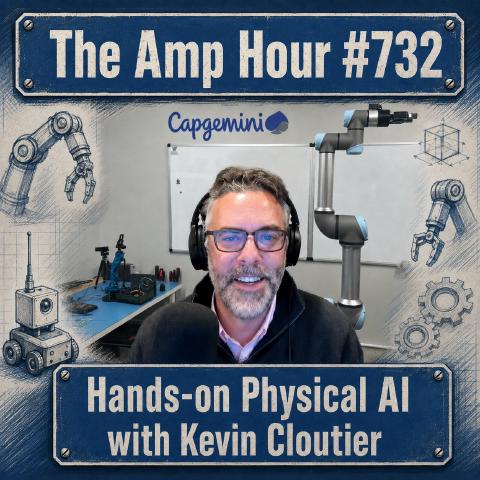
Download episode · 73 MB
Also on Apple · Spotify · YouTube · RSS
Show Notes
Kevin Cloutier is the North American Lead for Physical AI at CapGemini, a global engineering consulting firm. He is a computer engineer who is passionate about taking complex computations to the edge. He joins Chris to discuss the transition from legacy, statically programmed factory robotics to modern, imitation-learning-based “Physical AI,” building and calibrating the affordable $200 3D-printed SO101 robot arm using the LeRobot open-source framework or Intel’s Physical AI Studio, and orchestrating complex robotic systems entirely on local edge hardware.
Timeline
- Chris welcomes Kevin Cloutier to discuss “Physical AI” and how it relates to robots and things that move in the physical world. (00:00:15)
- Meeting at Embedded World: They reminisce about meeting at the Canonical booth in front of a robot demonstration, which you can see in the Embedded World Demonstration Video. (00:02:10)
- Trade Shows and Geography: Chris and Kevin discuss Embedded World in Nuremberg, Germany, upcoming SPS, and the high concentration of manufacturing robots in Europe compared to the US. (00:03:50)
- The “Unicorn Developer” Shift: Kevin talks about his background in computer engineering and how the “unicorn developer” has shifted from the full-stack web developer of the 1990s to someone who can operate, program, repair, and train physical robots. (00:06:05)
- Factory Robots vs. Edge Cases: Contrasting legacy, statically programmed factory robots (like ABB or Universal Robots hanging car doors) with modern generative AI approaches capable of handling real-world edge cases. (00:09:15)
- The Robotics Software Stack: Demystifying the layers above motor drivers, including Real-Time Operating Systems (RTOS), Linux, and message-passing frameworks like ROS (Robot Operating System) and ROS 2. (00:12:40)
- Orchestrating Systems of Systems: Kevin describes playing tic-tac-toe using Vision Language Action (VLA) models, where a higher-level camera and computer vision system orchestrate the coordinates for the movement model. (00:15:10)
- The Evolution of Compute: How modern silicon, integrated GPUs, and SOCs have allowed the massive, heavy control boxes of legacy robots to shrink down to a small NUC-sized device mounted directly on the robot. (00:18:05)
- The SO101 Robot Arm: Introducing the SO101 3D-printed robot arm from Hugging Face, which democratizes robotics by allowing anyone to build a leader-follower setup for around $200. (00:21:20)
- How “Backyard Engineers” Learn: Kevin’s advice for firmware and hardware engineers stepping into robotics: follow the documentation, get it running, and then ask questions about what you don’t know. (00:23:55)
- Calibration and the LeRobot Framework: A look at using the LeRobot open-source framework to calibrate hobby-grade motors and define their movement limits. (00:26:40)
- Recording “Episodes” via Imitation Learning: How users physically guide the leader arm to control the follower arm while a webcam records the visual and servo coordinate data. (00:28:50)
- Training the Model: Organizing data into short 5-episode chunks to make deletion easier, and training the model locally on NVIDIA GPUs or in the cloud. (00:31:30)
- From Training to Evaluation: Moving from training to evaluating the custom model, and asking questions about action chunking, model stutter, and operating frequency. (00:35:10)
- Sensor Fusion vs. Pure Vision: The current dominance of cameras in physical AI, and the potential to fuse accelerometers and time-of-flight sensors on mobile robots like Autonomous Mobile Robots (AMRs). (00:41:00)
- Real-World Calibration Challenges: Kevin shares a story of someone knocking over his camera boom at Hannover Messe and how he used April Tags to quickly recalibrate the camera’s physical coordinates. (00:43:15)
- The Reality of Humanoids: Debunking humanoid hype and explaining why full humanoids are further out than the public thinks, due to immense hardware cost, degrees of freedom, and safety. (00:45:50)
- The Puppeteer behind the Curtain: Kevin points out that many impressive humanoid demos, like the Unitree G1 at Hannover Messe, are actually being teleoperated by an engineer standing nearby. (00:48:40)
- The Complexity of Robot Subsystems: Using Steve Crunch and the book “Exploding the Phone” as an analogy for how modern robotic systems have become too complex for a single human to fully understand. (00:52:15)
- Understanding SmolVLA and SmolVLM: Diving under the hood of Vision Language Action models, which are fine-tuned transformer models that translate visual inputs into physical robotic coordinates. (00:55:10)
- Local AI and the NPU: How modern System-on-Chips (SOCs) let engineers run models locally on the CPU, GPU, or Neural Processing Unit (NPU) using optimization toolkits like Intel OpenVINO. (00:58:15)
- The Joy of the Physical World: Why working with physical hardware and robots is far more creative and rewarding than optimizing spreadsheets or SaaS applications. (01:04:30)
- “If the Robot Can’t Kill You, It’s Not Fun”: Kevin shares his colleague’s favorite metric for a truly exciting robotics project. (01:07:10)
- Advice on ROS and “Cobbling”: Starting with duct tape and bubble gum, and learning message-passing frameworks like ROS only when you need to coordinate multiple independent robots. (01:09:30)
- Physical AI Studio Demo: An invitation to see Kevin showcase Intel’s Physical AI Studio with multiple active robots at the upcoming AI Infra conference in Santa Clara. (01:14:45)
- Find Kevin online at his website cloutier.engineer or on LinkedIn. (01:20:10)
Transcript
Chris Gammell: This is the Empire Podcast. Released August 26th, 2026. Episode 732. Hands-on Physical AI with Kevin Cloutier. Welcome to the Amp Hour. I'm Chris Gamble of Contextual Electronics.
Kevin Cloutier: Hey, Chris. Kevin Cloutier. I lead physical AI for North America for a very large consulting agency.
Chris Gammell: Welcome, Kevin. How are you doing? Good, thank you. Thanks for having me. It's great to see you again. Physical AI, I think we have to disambiguate that is mostly robots. Is that right?
Kevin Cloutier: Yeah, it's funny. So we've been having this discussion for the last like six months or so. When I first met you at Embedded World over in Nuremberg, that was the du jour term, physical AI. And the way that I like to explain it is that it's using AI and connecting it to things that actually move in the physical world. And many times, most times, that's a robot, right? It could be an actuator, etc. But yeah, physical AI, that's the thing.
Chris Gammell: I mean, if I'm being honest, the skeptic in me is like, well, it's also a company who's trying to raise more money. Right, right. It's everywhere. You know, that's a VC problem. That's not a company problem. That's just like a reality of our industry. It's just like, okay, yeah. But robots are the things that like nerds care about, you know, and things that move. And yeah, like how you define a robot, you know, whatever. It doesn't matter. But things that move that are programmatic and now have AI, it's awesome.
Kevin Cloutier: It's fantastic. And robots are sexy. Like they bring people to the booth. People love to see things move, right? And physical AI is now the term that the VC love.
Chris Gammell: That's right. Yeah. So I was hanging out at the canonical booth, standing in front of a robot. Kevin walks by and he's like, hey, I worked on that. And I'm like, oh, we're gonna talk. That's awesome. Yeah.
Kevin Cloutier: It was the first time I had seen it in the real world. Oh, really? I didn't realize that. Yeah. And I was talking to the guys that helped build it as well. And they were like, no way. I was like, yeah, I walked right into it. There's this guy. He's standing next to the robot. So yeah, it was very fun. That was a fantastic show. Biggest show. One of the biggest shows in the world.
Chris Gammell: I am a huge fan. I have to say, if I never went to Nuremberg again, I would not be sad in terms of just this. You know, it's a great city. I've just been there enough. Yeah. In terms of like, I don't go to Europe that often. I'd love to see other parts of Europe, but man, you can't beat the concentration of nerds. You know, so yeah. Absolutely. Have you been at Hanover Messy? I've not. No, I think we talked about that a little bit on email or something. Yeah.
Kevin Cloutier: That's a great one as well. And SPS is coming up in Nuremberg again at Nuremberg Messy in November. I think it's North American Thanksgiving or United States Thanksgiving time, which would be cool. So yeah, I love to get out there and see different people, different robots in different places. So there's a concentration, different types of robots in different areas. So when you go to Europe, you see a lot more, at least I do anyway, a lot more manufacturing robots and a lot more focus on that than I do currently in the United States. I think the United States is catching up on that. But it's really cool to just see different things in different places.
Chris Gammell: Yeah, that's great. And so you are kind of doing like leading edge research, doing demonstrations, doing, you know, hands on teaching, learning. I mean, every time I talked to you, it was just like infectious, like how excited you get. I mean, as soon as I talked to you, it was like, oh, this Kevin is going to be perfect on the amp hour. So like, how does that work? Like, what is the what's the nature of your work in doing these leading edge things? And then I'd love to also then take it back because I think a lot of our listeners, present company included, like I didn't really get robots, you know, like so I know how to how to step into that space.
Kevin Cloutier: Yeah, I should I should qualify this entire conversation. Right. So I'm really not a roboticist. I'm a computer engineer. So I started off in computer science, and then got into computer engineering, electrical engineering, etc. And, you know, down to soldering and, you know, building my own, you know, embedded systems, my own PCBs, designing them, etc, etc. And I always wanted to get to the edge. I've always had this conversation with all my colleagues and friends over the last decade or more about how we should be taking these complex computations and putting them towards the edge. And in the last few years, robots and large language models and small language models and AI and everything has come together in this this this great place to be right now from computer engineering and AI and robotics. We can take all those skills and all of a sudden that the unicorn developer of the past, if you may remember 20 years ago in the dot com, the unicorn developer was somebody who knew the full stack. Right. And it was like from database all the way up through CSS and and web, you know, ASP.net and all those things. Right. That's shifted a little bit now. Now, the unicorn developer is somebody who understands not only how to operate that robot, how to program that robot, how to fix that robot and how to train those AI models. Right. And I feel like that's really exciting place to be. And I'm always trying to look towards what don't I know. And it's a lot. Right. I don't know a lot, but I'm always trying to focus on how do I learn that next thing? And robots are really helping me learn more about things that I don't know. So I'm really interested in it.
Chris Gammell: Kevin, I regret to inform you that I make this mistake as well. Dot com was 30 years ago. Oh, my God. I know. It's like, oh, no. I'm like, yeah, 1995, you know, 20 years ago. 30 years ago. It's like, oh, crap.
Kevin Cloutier: Right. Tim Berners-Lee, right? Yeah. Right. Right. I'm so old. I have the Santa Claus beard going on here. Right. But yeah, I mean, that whole transition, that career of knowledge, I've always been trying to get to the next thing. And my current position at this current very, very, very large consulting firm, I think the second or first in the world for engineering. I have the ability to do funded research. And I have a very large semiconductor client that funds my work. And I can go in and try to push the envelope on their chipsets and figure out, you know, what can we do with this? How can we demonstrate this to people? How can we get people excited about that? And part of my role is to go around the world showcasing things that I build to get people like you and your listeners excited about, hey, let's build things together. And I cannot be more happy when someone says, let's chat, let's build something, et cetera, because that's what it's all about, man.
Chris Gammell: Can you give us an idea? So I definitely agree on the, I mean, I think anyone who's like an industry watcher now as well, they'll see physical AI and, you know, for all the hype that's out there, there are some just AI systems are just perfect for reinforcement learning generally. And so maybe if we just take a peek back, what it would have taken 20 years ago to just control a robot in the same way that they're being controlled now, like in terms of one engineer, 10 engineers, a hundred engineers, a company of engineers to build a robot back then versus now, like what did it used to be like?
Kevin Cloutier: Yeah, it's a whole different world. It's almost like medieval times to current times, right? And most of those robots today, like if you go into a factory, a lot of them are and will be for quite some time, if not forever, control systems that are statically programmed, right? Over and over again, you do the same thing. And what that takes is a team of engineers who work out the kinematics and reverse kinematics, et cetera, of whatever action it is. So for example, let's say you take a big, I don't know, ABB robot or big robotic arm, universal robots, you are 5E or 10 or whatever, a bunch of different robots I'm throwing at you, but just say robotic arm. And you want to put a car door on, right? In your automotive plant and you're hanging car doors. Well, that task is the same task every single day, every second that you do it, right? So that's a really structured program that you can write. But let's say, for example, you're a large package distributor, let's say FedEx or UPS. And these are not clients of mine. I'm just giving you an example where you have, let's say you go down to Memphis and FedEx and you see like all of the conveyor belts and the packages and there's robotic arms that are picking things up one at a time, putting it in places, right? Great, great. What happens when it falls off? What happens when there's an edge case? And in most cases today, in edge cases, a human being goes and picks it up off the ground and puts it back on the conveyor belt, right? But using generative technologies, using LLMs, using small language models, using vision language models and vision language action, we can use imitation learning to train these robots that when there is an edge case like that, switch your mindset from your static control system or your standard control system, and then pick up that package and put it back on, right? So there's a combination of what we call Greenfield and Brownfield. So a combination of what you're currently doing, which would be Brownfield, with some new green technologies, Greenfield, putting that together to have even a better solution than you currently have. Yeah. I hope that answers your question or if I just... No, it does.
Chris Gammell: It does at length. I'd love to like, you know, kind of build up the stack too. So like when I think about like, you know, driving a motor, like very most basic thing is like an H-Bridge, right? Like H-Bridge is going to drive a motor. If you've got steppers, you've got different timing on doing that sort of thing. Most people are not doing that in the robotics industry, right? That is a solved problem, but a third party problem or like a buy a module that does a thing. So then the logic that's on top of that, that's now a direct drive from like a, from a, from a Linux-based system, a microcontroller-based system. Like what is the next step up from the direct electrical driving of a motor?
Kevin Cloutier: Really interesting that you bring this up, right? Because you have RTOSs, like real-time operating systems versus general purpose GPOS operating systems, right? So you have Linux and Ubuntu, which you're very well familiar with, which have RTOS type kernels, right? So you can get RTOS-like real-time feedback, et cetera. But that's really the number one question is, hey, do we need real-time? Do we need semi-real-time? Do we not care about the scheduler, et cetera? But a lot of, once you start to move up the chain, let's say you have a quadruped and you have all these different servo motors on it. Well, I don't want to communicate to all those servo motors like one at a time. I want to have a messaging system. I want to have an operating system, robot operating system, ROS2 that it's known as, to communicate those messages. I want to be able to utilize frameworks that allow me to communicate to multiple robots, right? So that problem that you're talking about, yeah, it's a solved problem, but it still exists. It's just a layer deeper, right? And so it's how far up the chain do you go? And right now, I'm at that chain that's in the OS level, in the RTOS, in the Ubuntu, in the Canonical level, et cetera.
Chris Gammell: Well, actually, kind of the VLA kind of thing seems like it's even another step up as well, right? So like the logic that's driving the motors is one thing, but then the intelligence that actually is telling it to do the other, you know, the things on top of it, the actual, so just to take it back to like that ABB example, like doing reverse kinematics saying, go from point A to point B, they need to figure out all of the angles that need to happen, all the drives that need to happen to make it go from A to B. That's now quote unquote solved, but now we're layering other things on top of it as well, saying, okay, yeah, we already know how to get to A to B, but why we're going A to B is because of input A, sorry, input X, input Y, input Z, those sort of things. Right. Doing some intelligence on top of that.
Kevin Cloutier: It's now systems engineering, right? Well, it's always been systems engineering, right? But now it's a harder systems engineering problem where the example I gave you before we started recording about playing tic-tac-toe. So this is the big demo that I'm bringing to AI Infra in Santa Clara in a couple of weeks. And the idea is using vision language action to play tic-tac-toe. Now for your listeners who are not familiar with VLAs, most of them, or at least the small sizes that I deal with, they're good at one task. So you can train it to pick something up and put it somewhere else, right? Or you can train it to pick up, let's say a cube and put it in row one, column one of a tic-tac-toe board. And then you can train it again to do row one, column two, right? And train it again, row three, column three, right? So you have to do all of that training. But it's not good about figuring out where my next move should be. So the systems of systems comes into play where you need to then figure out what is the move you need to do, right? So at a higher level, even a step up from there, you have another camera or another image that looks at the board and you're using systems like Intel Getty or some other programs to figure out where are the pieces on the board, right? Where are they? And then feed that into another model that says, okay, your move for the red cube should be 3-2. You get that information back, feed that back into the VLA to get your coordinates on actually how to do your move, right? It's this whole orchestration of things. You need to all do it in 33 hertz or less, right? Yeah. That's wild. Yeah. So when you asked originally about that question about the differences between yesteryear and today, it's the compute, right? And without the compute, without the silicon, none of this happens. Right. We're not working on microcontrollers anymore. We're running on computers with integrated GPUs that are the size of a Raspberry Pi. It's just amazing. Yeah.
Chris Gammell: Yeah. A long time ago, Sean Meehan was a guest on here and he was buying old ABB robots. And I just remember him talking about like, he was ripping out the control system, but the control system was like a box with heavy cables. And like that was sending, you know, signals literally down the wire to these drivers. And like, that feels like that's that old era. He was trying to modernize it for more customized control. But like, that's kind of my, my context around like how that old stuff works. Now you're saying that old, that entire box, all that cabling now goes directly on the robot. You don't feed it, you know, go from A to B. You say, go pick up that thing.
Kevin Cloutier: Yeah. Think about, I don't know how, how in depth you got with that demo that, that, that you were standing next to it embedded world. So that was a universal. Can you explain what it is? Yeah. Yeah. Yeah. So it was a UR 5E, I believe universal robots 5E that had a conveyor belt in, in front of the robot and these 3d printed items. There was a cube. There was a gear, a star, et cetera, would go down the conveyor belt and using computer vision, using Intel's robotic vision and control. That was a system that you were, you were using there. It would pick up and determine where that item was, where it was going and how to move along the conveyor belt, the robot move along and then grab it at the right time and then pick it up, put it on the backside of the conveyor belt. So it was a repetitive demo that just kept going over and over again.
Chris Gammell: Into like a, it was also broken out into which, which category it was. So it like, it was labeled. Yeah. Right.
Kevin Cloutier: You had like three funnels and like all the orange ones went in one and all the red ones went in another, whatever it may be, but it was fantastic. Now, if you take a step back and you look underneath the, uh, the cabinet of where that UR 5 was, was mounted, there's a big control system. There's a big box and that box is the control system that, um, that, that you've, you are provides and it's awesome. It's how you control the robot. It's how safety is met. This is a cobot. So if it bumps into you, it stops. It's a very sophisticated, uh, robot, uh, robot.
Chris Gammell: Accelerometers, things like, uh, stall motors and stuff like that. Everything. Right.
Kevin Cloutier: Um, but how do you control that from the system of systems that we're talking about? Right. So I bet, and I didn't look underneath your table, but I know because I had the same demo at my table. Um, I was using a, uh, a, a pre-release Intel machine called, uh, Panther Lake, which is known as Intel core ultra three, which is the cutting edge, um, that new SOC, which is just, it's just fantastic. But great.
Chris Gammell: So it can, uh, mid mid names, you know? Yeah. Right, right, right.
Kevin Cloutier: All the, all the silicon companies are just, all the names, they change left and right. But, but now that the marketing name is, uh, is core ultra three. So, you know, everyone's listening, go buy one. But, um, I'm, I'm thinking you had the same, same setup, but it's a little box, uh, about the size of a nook. If you remember the nook, about the size of it. I'm so old now. I'm going to date myself about the size of a CD. No, I have a couple of mine right now. Yeah. Yeah. All right. CD.
Chris Gammell: I actually, I'm cleaning my lab. I have some right here. There you go. Yeah. I've got a, look at that.
Kevin Cloutier: I've got a whole, whole rack of them here because I had something I was going to show your viewers, but I didn't realize you had listeners, uh, instead of yours. But, um, but that machine would handle all of the, the computation, all of the, uh, inverse kinematics, all of the, all the vision, all at the same time, and then communicate over Ross, over ethernet or ether cat to the, uh, to the control system. And all that control system is doing besides all the safety and all the really important stuff that we talked about earlier, but you're just feeding it where to go. And what to do and when to grasp and when not to grasp. So all of the logic, uh, the, that you're looking to move that robot, it's really now on a different box than it used to be. Got it. And, you know, five years ago, you didn't have that computation. You didn't have that capability.
Chris Gammell: And now, and now what I'm hearing you saying though, as well, like we're starting to shrink those things together now, even more. Right. So like, if you're not buying an off the shelf universal robotics thing, you might be building your own Rob robot and then you start to put your motor drivers next to your computation, next to your, your camera inputs, all that other stuff too.
Kevin Cloutier: Exactly. Right. So some of the stuff that I, that I had here to show you, one of them is a box about the size of a raspberry pie that has, uh, an AI accelerator on it, um, for, for vision, as well as, uh, language models. Some of the robots that, um, I was show, I was showing you earlier, one of them is known as the SO 101. Sure. You're familiar with this. If not the name, you've seen it. It's a 3d printed robot that you can print from hugging face, um, and the robot shop. So it's about $200 us dollars for the motors. And then you can print it for four or five bucks of filament. Um, or you can buy it printed for, I think four or five bucks. Right. So it's not, you can get a working robotic arm system that you can play with and learn about imitation learning for 200 bucks, which is just extraordinary. Right. Yeah. Um, it's just crazy. So a lot of what I'm doing now is with those robots because they're not true professional grade robots by any means, but the entire system of systems that drives them is the same. So they're great to communicate ideas with.
Chris Gammell: Yeah. Yeah. Yeah. Yeah. Well, and then what about like skill sets to do this? So, you know, you're mentioning things that might, you know, uh, our audience spans a wide, wide variety of skill sets, but I think mostly about like low level. I think about myself. I think about myself, Kevin. Nice. Like hard. I think about you too, Chris. Oh, thanks. Uh, like, uh, people that are moving up the stack, thinking about moving up the stack like this. So now I'm a firmware person that say who has hardware capabilities, who has, uh, some software capabilities. What should they expect when they're trying to put together this S 101 is a great example. So they're going to build their own robot and then start to, to kind of glue it all together. What, including software, what does that look like?
Kevin Cloutier: Yeah. It's actually a really good, good example of a really good question. So what I was alluding to when we first got on the phone was there's a ton of examples out there for specifically this one robot. And you can go and build this on a laptop and you can make it work. And that's where you should start. Follow the, you know, the instructions one at a time by the robot, assemble the robot, install the software and run it. You're not going to understand it, right? You'll understand the stuff that you knew, right? So if you're a firmware engineer, you understand the firmware, right? But what I would suggest is try to get it up and running and you will be able to, because the documentation on these things is so great. And there's such a vast community. But then when you're done and you've got it working, start to ask questions about what you don't know, right? The whole queuing mechanism of action chunks, whether that be ACT or whether that be small VLA, vision language action. Think about that and say, well, I'm getting 50 actions. What happens when I need 51? Well, I got to ask for 50 more. Okay. Does the robot have to stop? Well, yeah, it does. Wait a minute. No, it doesn't. I can ask for 50 while I'm at 30 and then I can combine those things together and make that robot smooth and travel smoothly. I guess what I'm saying is be curious and try to ask questions about the things that you don't know. And that's hard because you don't know what you don't know, but just try to get it to run and then try to learn a little more and a little more and a little more and then build your own system and then build your own robot, right? It's a progression of, I think that's the best way. For us backyard engineers to learn, right? Build upon the things that you were taught in your career and just keep going. Never stop learning.
Chris Gammell: Yeah. That's great. So, so in terms of like, what is actually, so you're buying this robot, it's got motors. It has a local microcontroller to actually understand where it is in space and that sort of thing. In terms of the computer side, what's actually on that side then? Is it actually running ROS like in a container? Is it running a vision thing in a container? Like what is the, what are the levels of?
Kevin Cloutier: This is even simpler. So if you use the robot framework, which is L E R O B O T. Like a French robot. Right. Exactly right. Or if you use like, like Intel's physical AI studio that supports this robot as well. Both are free and both are fantastic. But so let's say you get the parts in the mail. You bought the servo motors. It comes with wires and you could even buy the 3d printed parts for another five or 10 us dollars, or you could put them yourself. So you've got it all in front of you. There's tutorials on how to put it together, how to slide the motors into the parts to make your arm, right? That's done. You can do it in a couple hours. First time you can do it in two hours. I can probably now do it in a half an hour because I've done it so many times. Next step is, I need to calibrate my motors, right? So every motor comes out of the factory and it has an ID and these are hobby grade, you know, motors. They're not $4,000. That's why they're $200 for all the motors. For all the 20,000. Right. Exactly right. So they all come with the same ID. I believe it's one, right? But you need to be able to communicate with them via ID. So there's a calibration process and it's really simple. It's all documented. It's like low robot calibrate, enter, right? And then it goes through and it says, okay, move the robot into a neutral position. It shows you a diagram, what that is. Hit enter. And then when you're done with that, you move the robot into every position, up, down, left, right, every position it can make. And the robot software learns what the calibration is. How far to the left can it go? How far to the right can it go? Et cetera. And then from there, you start to use, like I said, physical AI studio or the robot framework to record videos. So when you have two of these robots, they come with two, by the way. So when I say it's 200 some odd US dollars, you get two. You get a follower, which is the robot that picks things up. And then you get a leader, which is the robot that you control the other robot with.
Chris Gammell: With like your hand directly. Yeah.
Kevin Cloutier: So you control the leader robot to pick up things with the follower robot. And when you do this within the framework and you have a, you have to have a camera. So add in some cost for a camera. You can use web cameras, et cetera. You have a camera that records and you're recording what you're picking up. So you're recording vision. And then you're recording all the data from all the servos on the motors. And you're coordinating this data together and saving it together. So at a later time, you can play that data back and you can see exactly what the robot saw at the position that that robot was in.
Chris Gammell: Did I lose you yet? Okay. No, no, no. This is actually great. This is, um, this is less complex than I would have guessed actually. I mean, so like in my mind, I'm like, oh, well, I have to like learn. Okay. Here's, here's the dumb thoughts. I'm like, oh, I have to learn how to like draw green bounding boxes around things in a vision program. And I have to run containers and I have to like learn how to drive Ross. And I, I don't like just like things that I'm like, I've built all these things up in my head, but like the way you're explaining, I'm like, yeah, I can do some of these. The way Kevin says, it sounds great, actually.
Kevin Cloutier: So I'm making it be as simple as possible. Right. But it is simple, but that whole learning thing that I talked about earlier, you can do this all on your, your, your metal, all on your, you know, Ubuntu box. Right. Like would I know, I wouldn't suggest that. Right. I would suggest having a container, et cetera. But those are all things that I know how to do. And maybe a listener of yours doesn't know that shouldn't stop you. Go do it, build this thing and then figure it out later and then keep building upon it. Right. But so it's that simple to record data. You do that. Say they suggest they being a robot and the robot shop, they suggest you do about 50 episodes. So what I usually do is I do about 75. I do a little more than, than they ask for. And I have broken this up into sessions. So what I call a session is, let's say I want to do five episodes. So that's five picks and places. Let's say we're doing a pick in place. Sure. I'll do five at a time because you can say, I want to do five. And then if you mess up and you want to delete all that data, you've only lost, you know, three or four, where if you do 50 all at once and you want to delete all that data, it becomes a little bit more complex. It's figuring out how to take that data out. But so you do that. And then there's one command once you're all done to train your model, right? This is, this comes where a little bit more of the cost comes in. So you have to train your model somewhere. You usually can't train that on a laptop that you have. You're going to need a dedicated graphics processing unit, GPU, let's say a NVIDIA. So I've got a bunch of NVIDIA 5060s that I train on. I have like a DGX Spark that I train on, et cetera. Okay. You could do this in the cloud, probably for a few dollars. I don't have familiarity with doing it, but I bet it's not much. When I do it locally on these lower end grade GPUs, it's anywhere from two to like 10 hours, depending how long I train it. And the longer you train it, the more steps it does. But when you're done, you get a model. Okay. You get a little model.
Chris Gammell: And what is the software that does the training as well? Is that still Intel Studio and the robot? Yeah.
Kevin Cloutier: You could do it with Physical AI Studio. You could do it with the robot. You could do it in a bunch of the NVIDIA products, et cetera. If you want to just get going, stay in one framework, right? Learn that one framework and do it. And I wrote a post I can send you later, Chris. You may have saw the VLA post that shows you how to do all of this. So I went and documented the whole thing from soup to nuts, where you buy it to how you install it. And then I finish that calibrating and running your first training session. So it gets you up from soup to nuts. Now, there are a million of these. You don't need to go see mine. Just Google it and you'll find a million. But when you get that model, after you've trained it, then there's also programs that you can use to run it, right? So you can run that model and evaluate that model through the robot. Again, there's just a command. Yeah. You can evaluate it. This is where it really gets fun. Because once you've done that, then your whole world is opened up. And you say, well, geez, what can I do with this model? Oh, I could put this model in custom software, right? And then you get into that whole action chunking that we talked about earlier. How do I make sure my model doesn't stutter as much? How do I slow it down? I don't want to process at 33 hertz. I want to process at 15 hertz, right? And all these questions start to come in. Yeah, I'm going on and on again. But I can't speak so highly of this. This is really great. Yeah, it's really simple. You can be up and running in a day.
Chris Gammell: That's awesome. I think, yeah, it just felt very, I don't know. I think maybe my brain is very much like in the old days of like, oh, this is way out of my pay grade or what I can afford or whatever. In terms of the software, the access via this robot kit and things like it does sound like it's become democratized in a lot of ways. And like you said, even the GPUs are, well, let's not say anything about memory makers right now. But there is availability to rent if not buy.
Kevin Cloutier: Yeah, but the democratization, you're absolutely right. So if you and I got together, because I know your background, I know your skill set. If you and I got together, we could build this whole system ourselves, you and me. It would take us a decade. Yeah, right. Right. So like, because it's so simple now, that doesn't mean it's actually simple. It's more, I should say it's straightforward. But there's been hundreds of thousands of hours of people that have put into this effort to make it this simple. And now you and I can sit back and hit a button and record training data. And it's just, wow, Bob's your uncle. Yeah.
Chris Gammell: Yeah. Well, and exactly. And I think it's like, when I think about like, okay, there's a, we're moving a piece on a tic-tac-toe board. There's an X on a board. I think like, okay, well, you have a camera that's looking at an X. You have to detect that it's an X. And then you have to do all these things to make a, you know, to make motors do all these twisty, turny things. Yeah. And like, there is so much stuff, layers and layers down the abstraction stack. But like, I think the right answer is, don't worry about that right now. Right. Just get moving. Like literally get moving.
Kevin Cloutier: Right. Yeah. Don't worry about it. Just get it working. And once you get it working and now with, you know, with chat GPT and all the large language models and the clouds of the world, you know, the vibe coding, et cetera, it's fairly straightforward to get moving. Now that that's easy for me to say, because I have a ton of experience in electrical, computer engineering, computer science. So oftentimes I look at something and I go, well, that's really just wrong. If you do that, the house is going to burn down. Right. But, you know, not everybody has that background. But I still think that I've seen people that do not know anything about computers get up and running with these types of systems and do it quickly. So I recommend everyone to do it.
Chris Gammell: No, that's really, really great. What about the so cameras as an input model? That seems like a very natural thing that is very much in the zeitgeist right now. What about like other sensing solutions? Like are there accelerometers in the mix? Is there like sensor fusion or is it mostly just cameras right now?
Kevin Cloutier: Right. It's definitely sensor fusion. But right now I've only been concentrating really on cameras and camera input. They're the easiest to utilize. So I haven't really delved into accelerometers, et cetera, outside of the work that I've used done in the past. I mean, with these robots. But it's definitely a place that we need to go. So I brought this. You can see that your viewers can't. This is an AMR, AGV, you know, robot here. It's kind of weird with my background to see it.
Chris Gammell: It looks like a battle wagon. That's what, if I can describe it, it looks like a small battle wagon that Kevin can hold Yeah.
Kevin Cloutier: With omnidirectional wheels, with mechano wheels. So you can go like, you know, left to right without actually, you know, changing the direction, et cetera. Putting accelerometers on there. Vision as well as time of flight. Right. So a bunch of different sensors on that as well. But vision has really come a long way. And I remember a couple of years ago, I was on a bike ride and I had a text message come in and I usually, I'm a big cyclist. I cycle with one earbud in, which I know I shouldn't, I shouldn't have any earbuds in, but I do. I cycle with one in. I heard the ding and I said, Hey, to the assistant, please read the message. And it said something along the lines, a man licking an ice cream cone on a farm. I was like, what? And it, it read back the image. It was an image my brother sent of having an ice cream cone in the summer. And he was like, Hey, Kevin, you know, check it out. I got, I got an ice cream cone at the farm and read back and described the image. And it blew me away. I literally was on my bike thinking, Oh my God, vision has come so far. This is a few years back. And now the things that you can do, the really important thing, if you read my blog though, about some of the vision stuff is you got to make sure that you, you calibrate those cameras and that they're in the same locations. Right. And you may, I think it was Hanover Messy when someone knocked over my, my boom with my vision, not with my camera on it, which I never thought would happen. So it took me, you know, 30 minutes to get it back up and calibrated in the right location that the robot expects it at. Um, not a problem normally in your lab, but in the real world, those problems exist. So I went and wrote a program to calibrate the vision based off of April tags, which are like these 3d barcodes that you put them in a known location and you can figure out exactly where the camera is in the real world. Um, but again, those are things that you don't need to know today, but three months from now, after you have your robot up and running, you might say, Hey, I want to bring this thing somewhere. How do I, how do I do that?
Chris Gammell: Well, okay. So let's, let's zoom. Now we've kind of go on from motors all the way up to the VLA, kind of like the higher level processing type thing. Let's, let's keep zooming. Uh, let's talk, let's, let's talk about, uh, humanoids and my distaste of all of the fervor around humanoids. Just so I'm laying it out there, Kevin. Uh, what, what is your take in that space? Because I think that's actually a really good example of like, um, you know, fixed camera, fixed scenario, train data. And now you're turning around. So some people are out there turning around and saying, well, we can do anything. We can process the entire world. And it's like, Oh wow. That's, that seems now, now given what you've said about this, that seems like a near, near impossible task, you know, or very difficult at the very least.
Kevin Cloutier: Yeah.
Chris Gammell: I have to be careful what I say because of the industry.
Kevin Cloutier: Sure. And employers and whatnot. But, but I do agree, uh, that humanoids are further out than most non-technical people think, right? It's a very complex problem. The hardware seems great. You look at some of the unit trees and the G ones and they're dancing, et cetera. It's really cool. But let's get it in. Yeah. We can do a flip and the new Superman one who's jumping, you know, the, the, you know, over LeBron James, his head. Have you seen this? This is just came out in the last few days. Yeah. Yeah. Yeah. It's not jumping over his head. I just, he was an example of a tall person that I could think of. Um, but jumping very tall from, from a standstill, but the, those robots, the use cases are immense. So think about using, um, a robot in a factory to push, um, uh, product from one side of the factory to the other, where you used to have say a person do that work, right? But we want to automate our factory. We want to, uh, reduce injury and things like that. They're starting to think about putting humanoids there. Now it's great, but they're slow. Training is difficult, right? It's just not as far along as I think everyone thinks it is. Um, right. I don't know how else to put it.
Chris Gammell: And you've been very clear about safety as well. Right. So like, that is one thing where it's like, okay, we, we've talked about robots so far that are enclosed and caged and have big red stop buttons and humanoids just don't have that. So like, so then the onus is on the development of the, the world models and understanding like, oh, it has to like shut itself down, just shut it down, you know? Right.
Kevin Cloutier: And I'm not a guru by any, any means on this. Like I have not been to the factories at Boston dynamics or at Amazon up in, um, you know, North Redding, et cetera. Haven't been to those places. Um, they could have robots running around like crazy. Then I would just, it was just below my mind. Right. That's a wholly possible. But from what I see, uh, the safety aspects is, is really important. And then oftentimes I was literally on the phone call for an hour before this with the client who was talking about humanoids and we're talking about putting them in their, their warehousing and picking up very heavy packages and like boxes and moving them because it's really hard on humans to do this over and over all day long. Right. Right. But oftentimes I look at that and I say, well, the robot arm could do that. Right. So I know your viewers or your listeners can't see, but I have a robot arm behind me, a universal robot nine times out of 10, it can do that. Uh, you don't need the entire human. You don't need the torso. You just need an arm and a, and a camera. Right. But humanoids have a place a hundred percent. I just don't think they're there yet.
Chris Gammell: Right. Well, and I think when you're saying things like factory or like basically like semi-controlled environments, then customize more customized or even quasi customized, make a lot of sense. I think the humanoid, the reason that a lot of it gets headlines is like, oh, you can be out in the world doing anything. It's like, yeah, that's, that's a generalized case, which is very exciting and very sci-fi and tech. But like, right. From a profit driven perspective is like, oh, maybe not then, you know, like, do you really want to pay for all of these other actuators and balance and all the other things you have to do in order to get it to lift a crate? It's like, well, maybe we just make a robot that does that one thing, you know?
Kevin Cloutier: Yeah. Hannover Messi is a great example. So I was with a colleague of mine. We were walking around looking at the robots. There was literally a whole section of robots and there was a humanoid G1, a unitary G1 running down the hallway. And my colleague was really excited. It was like, check that out. Oh my God, it's running. Right. And I'm like, check out the guy in the black polo behind it. Cause he's controlling it. Right. It was all teleoperated. And like everyone was focused on the robot and I'm focused on the engineer going, oh, you see the puppeteer control. Yeah. Yeah. He's right. I see the wizard behind the curtain. Right. Um, but there are, there really are great use cases for humanoid robots. Sure. It's just, it's a heavy lift and no pun intended. And it's just a little bit more work than I think a lot of people are willing to do at the moment, but you want to build one, Chris, you and I let's do it, man. I've, I've got the humanoids, right?
Chris Gammell: The company. I bet you, I bet you have a, an in on a, yeah. Motor drivers and similar motors. I bet you, I bet your, your workshop is, is spec.
Kevin Cloutier: We've got the quadrupeds too. You know what I mean? Yeah. Oh yeah. We can do it all. Right. But I just think from a practical standpoint, it's a little bit further out than, than the average Joe thinks. Got it.
Chris Gammell: Yeah. I mean, uh, shout out to Aya Musa who was on the show a couple of last year, I think, but he was doing like the really low costs, like the rope drive ones. Yeah. Yeah. I love like that, that like driving costs down too. I do think that like some of it, we're not just going to get away from, right? They just, the cost of humanoid, just how many actuators are on there? It's got to be what, like 30, 40. It's just super expensive.
Kevin Cloutier: Just think of a hand alone about how many degrees of freedom are in a hand. Right. So when you start to actually grasp things, when you're not using a gripper and you're using knuckles, you know, 27, what, how, how many degrees of freedom are in a hand? So yeah. Yeah. The cost needs to come down. If you look at some of what's going on in China versus United States, um, and some of the political machinations that are happening with where you can buy robots from, some of the robots are, you know, five, $10,000. Some of them are a million dollars. And figuring out like how you go to market with that, it's going to be difficult in the next couple of years, figuring that out.
Chris Gammell: Yeah. I think also the complexity. So we're, you know, we started out talking about complexity of like building up these systems from like one motor up to, you know, one camera, one brain sort of thing. And then thinking about like in the humanoid case too, this is again, my perspective. So take that with a grain of salt is like just the complexity really starts to explode. It feels like, and I feel like there's like subsystems and you can have much like you talked about like having, you know, higher level processing, talking to a subsystem. So the leg, you just tell it to, you know, sweep the leg, sweep the leg, whatever it is. And you do that for multiple subsystems. You're not that old, Chris. Karate kid, I love it. All right. I got, I got references for days, Kevin. But, uh, um, yeah, I think the, uh, you know, having, having those multiple subsystems is a way out of that, but you still have to have someone building that. And it doesn't seem like there's enough of an ecosystem quite yet that like, once we get to the PC era where it's like, oh, well, there's just the leg provider or there's the tor, the torso provider. And it snapped together because of quasi standards that emerged. Then we're a little bit closer, but that's maybe a couple of years out still because of economics.
Kevin Cloutier: There's this great book. Um, I think I'm not quoting the wrong book called exploding the phone. If you've heard of this, um, it's about hackers back in the, like the pre Apple days, uh, in the sixties and seventies, where they would figure out how to make long distance communications, uh, Steve jobs crunch. Yeah. Yeah. Yeah. Right. Captain crunch. And the little blue box is exactly right. Right. And jobs and, uh, and what was the act were part of that at that time. Yeah. And I believe in the beginning of this book, it talks about, I hope I have the right book about the telephone system being like the first machine that was made that not one person could fully understand. I think it's the telephone system, uh, and robots are the same way now. You know, the, we went back to that unicorn developer of that full stack developer. You understood it all right in the nineties and I could get you together at amazon.com and, you know, a couple months worth of time, the subsystems and the greater systems of robots in general and humanoids so complex and you can't know it all. Yeah. Yeah. That doesn't mean you shouldn't try Chris.
Chris Gammell: Sure. Well, and I think there's, yeah, there's, there's a lot of, a lot of things to be, to benefit from, um, in that, in that, in that struggle and that learning. Cause you know, like literally I didn't know what VLA was until I saw, I saw your post the other day, so I did hear about it, but I still don't quite get what it is. Like, what is under the hood of a VLA? Like what, what is that just like another LLM like thing? Like what was actually input output? Yeah.
Kevin Cloutier: So like the, the one that I use that I've been doing research on is called small VLA, S M O L VLA. That's built off of small VLM, which is vision language model. Right. So there are these foundation models that are transformer models, um, that have been tweaked in a way that you can use imagery to pass it in and to get things out. Right. And these models need to be fine tuned. Um, they're not general purpose where I can just say, pick up this can of diet Coke that I have here on my desk and move it. I have to train it to do that. And then I take the model, the small VLA model and my data, and I fine tune that model to now make it a diet Coke moving model. Right.
Chris Gammell: Yeah.
Kevin Cloutier: So yeah, there's a transformer underneath it.
Chris Gammell: Got it. Got it. And I do think that, you know, as much as I'm, uh, maybe bearish in like the, the long term, the short, sorry, the short term of like economics of LLMs, like this is the, this is like the offshoots that we just don't see coming, you know, like, like just all of these that are doing all this stuff that are like enabling adjacent industries too, that are like, like, I, I never would have thought, thought this was a possible output when I first saw, you know, early chat GPT, you know, like, Oh, okay. Right. Yeah. A dirty limerick for me. Okay. That's funny. Like, but now controlling robots like, Oh wow. Okay. Like that's, that is cool. You know, that is really cool.
Kevin Cloutier: And it has its uses in and not uses, right. Where like it, the accuracy is not the greatest, right. That's really not good in a safety environment or an environment where you're putting a door on a car, et cetera. So everything has its own, own use case. But the other thing that's really interesting to me from my background and what I've been researching for forever now is how do we get whatever does your computation that's happening in the cloud? How do we get it locally? And I don't know if you follow hacker news or not, but there was an article the other day about, did you see the one about small VLA or small, small LMs versus large language models and is this like the smaller one 3.8, 27 versus the 2.4? Even, even smaller than that. But it was more of a, of a high level conversation about if we can get everything to be running on your phone or your laptop and we're almost there, right. I've got tons of examples of small language models running on very small compute. Then you don't need the data centers, right? So what I have in my community is huge conversations. Yeah. I don't know about your community down South, but in the Northeast, you know, huge conversations about, you know, how much land is going to be devoted, how many natural resources, sustainability, et cetera, for, for these data centers. And if you look a little bit down the road, if we start moving some of that computation out of the cloud and have it local and having it run on your iPhone or your laptop, et cetera, running locally. Like for example, I run a bunch of different models locally, Google, Quen models, Google, Gemini models, et cetera. I run them through a product called Olama. If you know Olama.
Chris Gammell: I got a, I got a, yeah. So 12, Gemma Ford's 12B MLX running behind me on Olama. All right. Awesome.
Kevin Cloutier: So you get it, right? So you can run that stuff locally. So you're not using the cloud, right? And if we can make that smaller and smaller, then make it for that, that normies can use, right? It comes on your phone. The Siri is now on your phone, et cetera. The computation needs are different as well. And that, that's going to revolutionize the industry as well. So there's always these next things.
Chris Gammell: When can I stop hearing about Sam Altman? Is that anytime soon, Kevin? I mean, I love making fun of him. No comment. Yeah, yeah, yeah. Yeah. No, I actually, I'm really excited. I'd love to see some of the stuff that's coming out of him. Walking around like, you know, embedded world, all these trade shows too. Like it's, you know, like Nvidia is obviously the 800 pound gorilla in the room, but like there are so many, all of the major chip vendors, like they're all putting gear in there. And that makes it possible to run these models, GPU, NPU, you know, CPU, all of these things. And like having them adjacent to each other as well. Like having, having a, you know, a listener on a device that's next to a motor controller running Ross and things like it. It's just like, it starts to, the, the architectures that I keep hearing about, like, I keep hearing about like, oh, well there's, there's like so many processing units on a thing. I'm just like, well, who needs this? Like, just give me one big one. But when you start to think about robotics and you have multiples that are running small things, talking to each other and intercommunicating, like, oh, that robots really make sense.
Kevin Cloutier: Killer, killer point. And my, my colleagues and clients are probably going to listen to this and, and argue and yell at me for not bringing this up earlier, but you just brought it up. So like the SOCs of the day that have a CPU, they have an integrated GPU, right? So you don't have to have that, that honking big size, you know, that, you know, from NVIDIA, you don't have to have a big desktop computer. You have an integrated GPU on the SOC and you have an accelerator, like a neural processing unit and NPU. Now, just this week, I was able to take small VLA, a vision language action model. I ran it on the CPU. Cool. Ran it on the integrated GPU. Cool. I ran it on the NPU. And can you explain what that is? I ran the model. Can you explain what NPU is? Yeah. The neural processing unit, which is a very small compute for accelerating AI on a, on a system, on a chip, on an SOC, et cetera. I was able to do it on all three different devices. So, okay. For anyone who doesn't know, what does that mean? Well, it means I could do three different things or more, right? I can do vision processing, the small VLA on the GPU. I can do some sort of categorization on the NPU. And then I can have the control system on the CPU all without impacting each other. And you could, you could also say, well, that's like threading. It is, but it's, it's using different devices, right? So the capability that we can do today is just amazing. And you can train everything on one system and convert it to others. So for example, you can use the NVIDIA stack to do all your training and you can use tools like OpenVINO to then convert your model to target specific devices, right? So I can convert the model that was trained to run on a CUDA device on a NVIDIA device. And then I can convert it to run on, say, an Intel NPU or an integrated GPU. It's just fabulous what you can do now.
Chris Gammell: And that's because at the end of the day-
Kevin Cloutier: Your options as an engineer are old.
Chris Gammell: It's just, it's just weights, right? It's just like, I had done a little bit of local stuff and I'm like, oh, it's just numbers. Like, you know, you're like compression of things. I'm like, oh, you're just chopping off the end of the number on the weight. Like, that's what you're doing. It's like, uh-huh. I mean, they're training it. But it's fine. Exactly right.
Kevin Cloutier: And there's like interfaces. Like, remember when we learned C and C Sharp and Java and all that back in the day. They're just casting. They're just casting. Which is about interfaces.
Chris Gammell: They're casting from a float to a char. They're just casting different interfaces. It's just like, oh. Right. You shouldn't do that sometimes.
Kevin Cloutier: A Uint8 to a Boolean. It's like, oh, it's a one. It's true, right? But some of that work is, it's a little bit tedious, right? And, but now some of the products like OpenVINO, you can feed in a model and say, all right, I want it to target this device, right? And there's a bunch of different ones out there that do this sort of thing. But yeah, it's just, it's a great time to be in the place that we're in. And I feel like what's happening with AI in the whole industry, like software engineering, et cetera, that's definitely out there, right? The people are being impacted by AI, et cetera. But there's also this spot where robots and computers and electronics all come together. And it's just this thriving area that you can still be creative and get your hands on things and not have to worry about the chat GPTs taking over just yet.
Chris Gammell: Yeah, it is interesting, like thinking, so like saying something outrageous and stupid, such as software is, is, is solved, right? Which is not correct. I, I realize that it's a stupid thing to say, but some people have said it and I have said it online. It's like, okay, let's just take that as a, as a new first principle. So then, then what, right? Okay. So you don't need to write software, but you still need to implement software, be creative with the, the products of software. And it's like, and the things you're describing sure as hell seem to fit that mark. And they get to be back in the physical world, which is way more interesting anyways. It's like, oh, okay. Way more interesting. The spreadsheet is more, 20 times more efficient. So my SAS company makes a little bit more money on revenue. It's like, ah, yuck. Like no robots.
Kevin Cloutier: Yeah. Yeah. I work with a guy who says something funny. Um, and I laugh every time he says it, if you, uh, if the robot can't kill you, it's not a fun. Exactly. Meaning that if it's not, if it's not big enough or fast enough to actually like, you know, do some real damage, go through a wall, et cetera, it's not fun. But yeah, it's, um, that software and AI is, it's definitely going through a weird period right now, if you're following it. And, um, I'm happy to be in a space where, uh, I am impacted by that. Like, like most people, but that I still get my hands on things and can build things and, and get it out there in front of people.
Chris Gammell: I mean, as some, as someone who's like customizing and build, building custom solutions, showing off hardware, showing off these, these different things like you do, how much of the work is that customization to, you know, pull in a new module, pull in a new vision capability. Like, like, uh, it sounds like there's a lot of, if you'll excuse the term, like not cop cobbling is the wrong word, but that that's the way the word that came to my head, you know, like the bringing together of things and the, and the system architecture, like you said, do you have to like pull in, do you, you know, do you kick off Claude code to go do some new custom thing? Or is there still so much to do in the existing space that it's like, I'll get there when I, when I need it sort of thing.
Kevin Cloutier: It's more of the ladder. Um, I don't utilize those tools in that way. I do vibe code, some things, you know, trying to figure out problems and get some ideas, et cetera. Um, but it's more of the, the, the, the ladder there there's, um, I don't know. I probably should use it.
Chris Gammell: No, no, no, no. I'm just, I'm just wondering, like, again, like this is me like mapping, like, okay, could I, could I try and do what Kevin does someday? Right. Like I've like the putting it together, like, like even just the levels I need to understand, like, how much do I need to know Ross? Right. We've mentioned Ross and we've mentioned on the show a little bit before, like, how much do you have to interact with Ross? If at all, I mean, is that
Kevin Cloutier: a thing for, for, for the system we were talking about earlier? You don't have to interact with it.
Chris Gammell: What about like, what about broadly though? Like, um, to like get like multiple cameras and all that
Kevin Cloutier: stuff. Yeah. If you want to start to work with multiple robots and you want to start to get more production, you want to get, you want to find a job, right. Doing this. Yeah. Definitely get into Ross, right. Buy a book. Yes. A book, like a physical book. There are some great physical books on, on Ross, uh, that you can read and they're a little dated, but like the
Chris Gammell: concepts are the same, et cetera. Well, what do people need to know about Ross then? Like, so again, like just assuming zero knowledge here, uh, I'm thinking about myself, uh, you know, that sort of thing. Like, so what do I need to know in terms of like what it's actually doing under the hood as
Kevin Cloutier: well? Oh, at this stage, if you don't know, you don't need to know anything. That's what I would say. Go back to my first thing of just get something running and the cobbling that you mentioned about cobbling things together. That's where every good engineer starts. Yeah. Duct tape. Duct tape and bubble gum. You tape them together. Yeah. Duct tape, duct tape and bubble gum. But then you look at that and you go, well, that castle is going to fall down. Maybe I should fix this. That's what I'm recommending you do to learn those things. And one of those things, when you build the robot, and let's say you want to build two of these, uh, that I'm holding up the, um, the robotic arms and you want to have them start working together and you want to have them communicating together. So picking up, say the diet Coke and passing it off to the other robot. Well, then that starts to get a little bit more complex and you should probably be using a messaging interface. You should be using some sort of Ross operating system, set it and forget it. Um, and you're not tying those two robots together, but they're working together in a disconnected framework, right? So the problems get more complex as, as your task gets more complex.
Chris Gammell: Got it. So, so Ross can be deployed for that communication mechanism. So Ross being like a higher level, it's like above the actual operating system as well. It's not the, yeah, it's, it's message passing, it's notification monitoring, all that sort of thing. Um, and so that's where that
Kevin Cloutier: subscribing to, to topics, I can say, Oh, I want to hear every, yeah. Yeah. Yeah. Pub, sub sort of stuff. Right. Um, and I, I'm not sure I looked this up a long time ago. I'm not sure why it was called an operating system. Um, because it, it does confuse, uh, many people. It's not, you don't install it and run. It's not like a general purpose operating system. Right, right, right, right,
Chris Gammell: right. Okay. Yeah. That's, that's interesting. Yeah. And so, so then like the, something like the, I'm looking at Intel's something studio, AI studio, is that right? Physically AI studio, physically AI studio. Okay. So that actually, that runs as like a binary that can do a lot of this handling and the talking to the lower level things. Sounds like. Physically AI studio is a kick butt,
Kevin Cloutier: um, uh, program that you can use to train your robots. Okay. Um, so it's similar to LaRobot. Um, it's all free and open source. Intel supports it. Uh, and they support multiple types of robots. They support the one, the, uh, LaRobot SO101 that I talked about here. Um, you can do simulation, you can do data recording, you can do training, uh, and deployment all through like a nice visual UI. So the stuff I talked about earlier, um, using LaRobot is all command line. So if you're a reverse to command line, um, there are other solutions and physically AI studios is one of them. And I can't speak more highly about it. If you're in Santa Clara, this is, uh, me selling my book here, which I don't have. I'm kidding. If you're in Santa Clara in a couple of weeks at the AI infra, I will have physically AI studio running alongside of a multiple of these robots working together, uh, on tasks and you can come play with them and stuff and we can chat about robots.
Chris Gammell: And the, is it a conference called AI infra? That's the name of the conference?
Kevin Cloutier: AI infra. That's the name of it. I N F R A. It's, um, a huge, um, AI conference. Perfect. Um, and I will be inside the Intel booth with these robots, which is really cool. So I'm really happy they invited me to do that.
Chris Gammell: That's really cool. Yeah. I think that that'll be a good, uh, yeah, people are in the area. That's a good way to kind of like take a deep dive real ticket, take a dip in the pool.
Kevin Cloutier: And yeah. Yeah. And it's a huge event. Um, so I know we have people coming from Europe to see it. Um, so it's massive and it's not that expensive for, for a ticket to go through and walk and see the, you know, see the show.
Chris Gammell: Got it. Last question. Just kind of like, as we see, and I'd love to just have like a, a mental parser, mental parsing engine for myself. So like I was watching like this generalist video today, right? So I don't know if you've seen generalist is like a startup that's doing this sort of thing. And they're, they're doing, like, uh, you know, it watches you and then it just trying to compute and all that stuff. I'm just trying to figure out like, where should I be skeptical? Where should I be excited? Where should I, where should I look next? And you know, that sort of thing. And like, this seems interesting. Yeah. Always the skeptics always in the back of my head, you know? So,
Kevin Cloutier: yeah, it's tough. So, you know, as I've been doing this a long time, I try to look at what excites me and what I think is going to be interesting for me to learn and not necessarily what the world will love. I think Twitter is a great example of this. Um, back in the day, I remember someone inviting me to Twitter. Oh, seven, oh, six. I thought that was the dumbest thing in the world. Yeah. And man, what's that? I mean, that thing just blew up. Right. So I don't have a crystal ball. So what I've tried to do in my career is to just really do things that I love, that excite me, that I can talk to human beings about to bring engineering to the masses, if you will. Um, I don't have a path, right. And I don't have an answer. I just love to do this work and tomorrow it's going to be something new. It's probably going to be not, not transformers. It's probably going to be more into like trust and world models, um, and things like that. Um, it's going to get out of, I think, I think we're on the, uh, the Gartner, uh, hype cycle, the Tropha dissolution, the hype cycle with like agentics and transformers and whatnot. Um, but we'll see. I mean, that's just what I think. It doesn't mean that's what it'll be. Okay, great. Well, I know you have to
Chris Gammell: go. Um, it's a great, great way to net. Yeah, exactly. Uh, so people can find you at AI infra. Well, can they find you online anywhere? Maybe just LinkedIn is the best place to follow you,
Kevin Cloutier: follow your posts. Yeah. LinkedIn is probably the best place. Um, so my full name, we could put it in the description. Um, and yeah, that's probably the best place. I've got a website too. It's cloutier.engineer.com. Um, C-L-O-U-T-I-E-R. Go check it out. Okay. All right, Kevin, thanks so much
Chris Gammell: for being here. Really appreciate it. I'm sure I have many, many, many follow-up questions about robotics and thanks for sharing your knowledge. Cool, Chris. See you later. 菜菜菜
Speaker ?: We'll be right back.
RoboticsPhysical AIIntelCap GeminiVLAROSOpenVINOPhysical AI Studio
Keep current
Every episode, plus the occasional job post, in your inbox.